Brevo alternatives when transactional email is the real job
Brevo is a marketing platform with a transactional API attached, and that is the whole story behind most searches for an alternative. If your product sends receipts, password resets and alerts, you are paying for a campaign editor, CRM and automation builder you may never open, and your API email shares one volume allowance with every newsletter. The cleanest fix is usually to move only the application mail to a transactional-first provider (Postmark, Resend, Mailgun, Amazon SES or MailerSend) and leave Brevo for campaigns if you still want it. Prices below were read from vendor pages on October 7, 2026.
What pushes teams away from Brevo
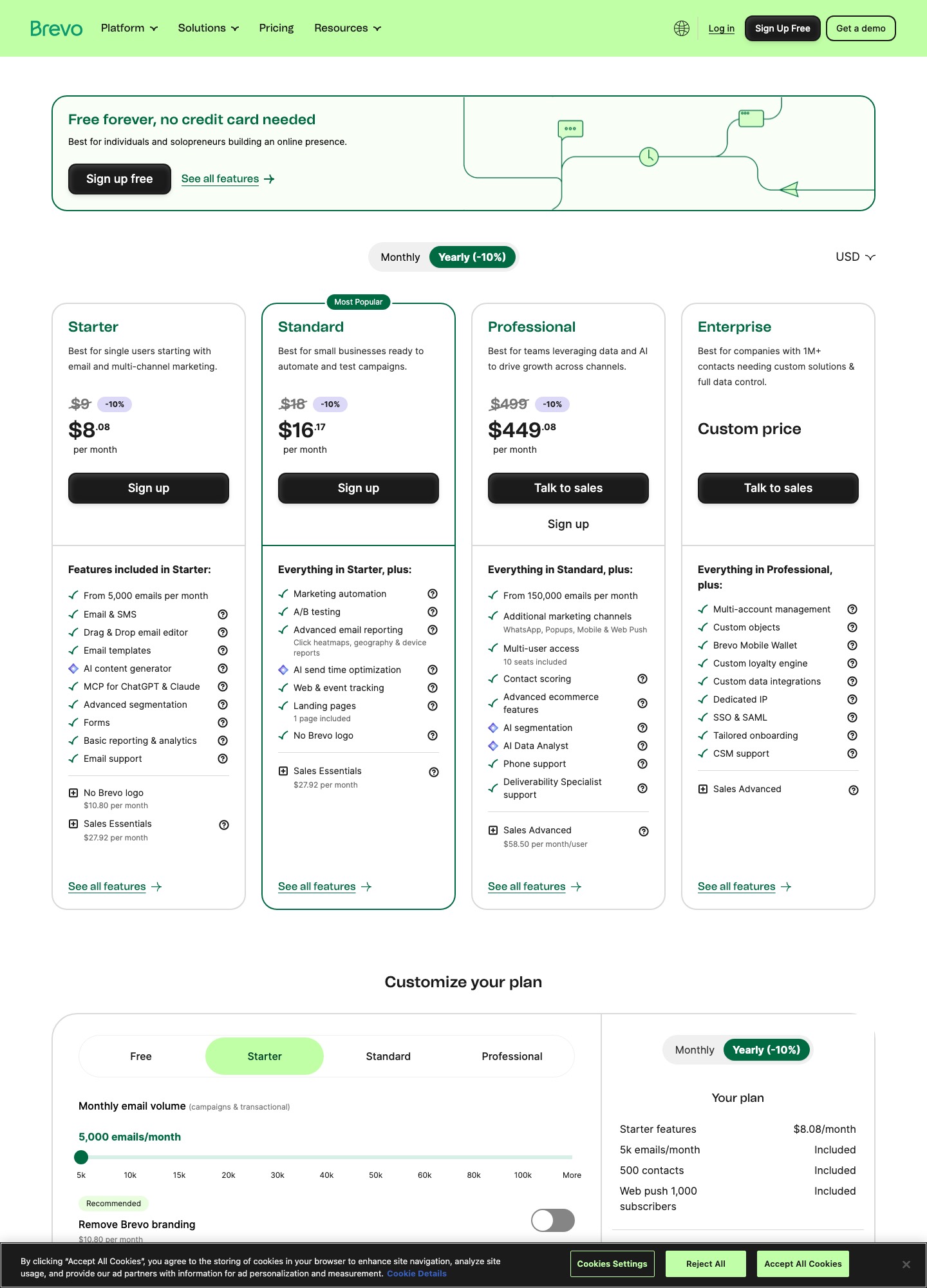
- One volume pool for two jobs. The volume slider on Brevo's pricing page is labeled "Monthly email volume (campaigns & transactional)". A big newsletter send and a burst of password resets draw from the same number, so a marketing launch can change what your application mail costs.
- The free plan is daily, not monthly. Brevo's pricing-plans article gives the Free plan 300 email sends per day. That suits a trickle of notifications but caps a launch-day signup spike, regardless of the monthly total.
- The paid tiers are built around marketing features. Starter ($9 a month) and Standard ($18 a month) both start at 5,000 emails per month; Standard is the one that adds marketing automation and A/B testing. Neither is priced for a developer who needs logs and webhooks and nothing else.
- A steep step at the top. The Professional plan starts at $499 per month and covers 150,000 to 10 million monthly sends with 10 user seats. A company at 120,000 emails a month is deciding between a volume-priced lower tier and a plan priced for something much larger.
- Yearly discount, monthly commitment. Brevo applies a 10% discount to yearly plans; on the live page the Starter card shows $9 struck through and $8.08 per month billed yearly.
Cost for 5,000, 50,000 and 100,000 emails
Brevo's Starter plan is $9 for 5,000 emails a month. Between 5,000 and the 150,000 start of Professional, the price follows the volume slider, so set it to your own number on the pricing page; I am not quoting a mid-tier figure I could not read directly. For the alternatives: Amazon SES is $0.16 per 1,000, which is 5 × $0.16 = $0.80, $8 and $16. Postmark Basic starts at $15 for 10,000, and its slider on Postmark's pricing page read $55 at 50,000 on October 7, 2026; 100,000 is not one of its stops (the nearest, 125,000, reads $115), so check the slider for that volume. Mailgun's plans are $15 (10,000), $35 (50,000) and $90 (100,000). MailerSend lists $6.30 for 5,000 and $31.50 for 50,000. Resend lists $20 for 50,000 and $90 for 100,000.
| Provider | 5,000 | 50,000 | 100,000 |
|---|---|---|---|
| Brevo | $9 (Starter) | Set on slider | Set on slider |
| Amazon SES | $0.80 | $8 | $16 |
| MailerSend | $6.30 (Hobby) | $31.50 (Starter) | Not published |
| Mailgun | $15 (Basic, 10,000 included) | $35 | $90 |
| Postmark Basic | $15 (10,000 minimum) | $55 | Not a slider stop ($115 at 125,000) |
| Resend | Free covers 3,000; Pro is $20 | $20 | $90 |
Choosing among the five
MailerSend is the closest in spirit. Its pricing page pairs an email API and SMTP relay with bulk sending, verification and analytics in a hosted account, so the move feels less abrupt than going to a bare API. Its Hobby plan at $6.30 for 5,000 emails undercuts Brevo's $9 entry, though it is limited to one domain and five seats.
Postmark makes sense when a failed receipt is a support ticket. You pay more per message than Brevo's entry tier, but you stop carrying a marketing suite's complexity. Resend is the lightest option for a TypeScript team; its Free plan covers 3,000 emails a month but only 100 a day, which is a smaller daily allowance than Brevo's 300. Mailgun fits when you also need inbound routing or an SMTP relay for older services. Amazon SES is the cheapest line by a wide margin and the most work, because logs, bounce handling and dashboards are yours to assemble.
If your product is a SaaS with billing events
If you run a SaaS and want billing-triggered lifecycle mail and transactional mail in one tool, Sequenzy is worth a look. Its pricing page lists a free tier of 2,500 emails a month and $19 for 15,000, and it lists Stripe, Paddle and Lemon Squeezy among its integrations. Compare it against the transactional specialists above before choosing.
What moving transactional mail out of Brevo involves
Webhook timestamps
Brevo's transactional webhook reference returns several time fields, and not all use the same zone: ts_epoch and ts_event are UTC, while the human-readable date field is in CET/CEST. If your event table keyed on date, store the UTC fields instead before you start comparing old and new delivery timelines.
Templates and contacts
Transactional templates built in Brevo's editor do not export to another provider's template language, so plan to rebuild them or move them into your own codebase. Contact lists do not need to move at all if the application is the source of every recipient; only suppression data (hard bounces, unsubscribes and complaints) must travel, and that export should happen before you disable the old sender.
Sender domains
Add the new provider's SPF and DKIM records on a fresh subdomain rather than editing records Brevo already relies on. Leave the Brevo records in place until the campaign side no longer needs them. If you keep Brevo for newsletters, the two providers can coexist on separate subdomains indefinitely.
Related pages
See the Resend pricing breakdown, the MailerSend pricing guide, and transactional vs marketing email for why the two streams are worth separating.
FAQ
Can I keep Brevo for newsletters and only move transactional mail?
Yes, and it is the lowest-risk path. Use different sending subdomains so a bad campaign never touches the reputation of your receipts.
Is Brevo's free plan enough for transactional email?
For a small app, yes: 300 sends a day. Once a launch or a batch job can exceed that in a day, you either upgrade or move.
Which alternative is closest to Brevo's feature set?
MailerSend, since it also bundles bulk sending, verification and analytics beside the API. Postmark, Resend and SES are narrower and more developer-oriented.