Mailgun alternatives for developers who hit a plan boundary
Mailgun does a lot for its price: an email API, an SMTP relay, inbound routing and validation, from $15 a month. The searches for alternatives tend to come from three plan boundaries rather than from dissatisfaction with the product. Basic allows one custom domain and keeps logs for a day. Its overage rate is $1.80 per thousand emails, the highest of the paid plans. And between Foundation's $35 for 50,000 emails and Scale's $90 for 100,000 there is a wide gap to plan around. This page explains where each boundary falls and where Resend, Postmark, Amazon SES, MailerSend, Mailtrap and SMTP2GO land by comparison. Prices were checked on October 7, 2026.
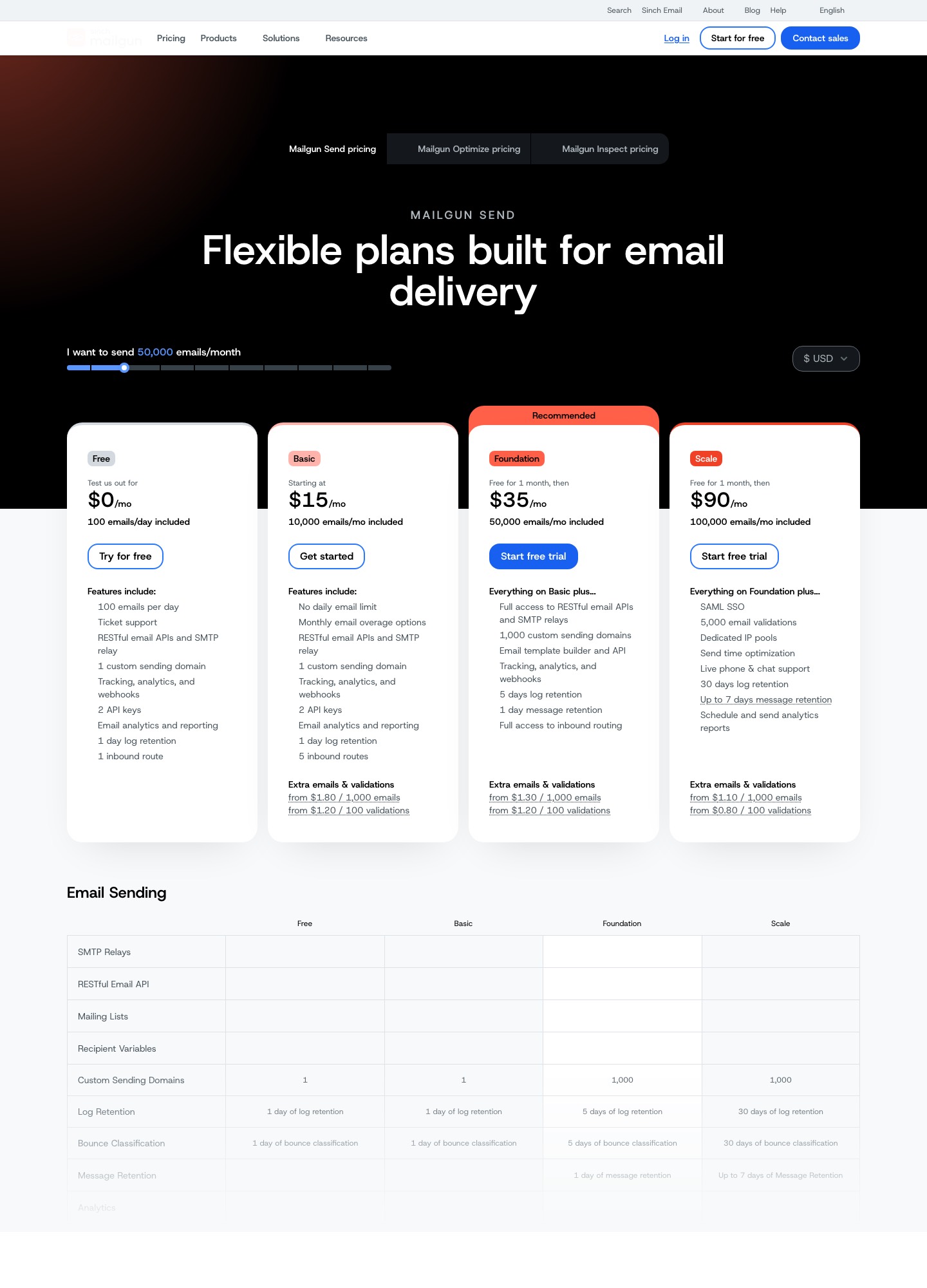
The boundaries on Mailgun's own pricing page
| Plan | Price | Emails included | Log retention | Custom domains | Extra emails |
|---|---|---|---|---|---|
| Free | $0 | 100 per day | 1 day | 1 | None |
| Basic | $15 | 10,000 | 1 day | 1 | from $1.80 per 1,000 |
| Foundation | $35 after a free first month | 50,000 | 5 days | 1,000 | from $1.30 per 1,000 |
| Scale | $90 after a free first month | 100,000 | 30 days | 1,000 | from $1.10 per 1,000 |
Three details change real decisions. First, the template builder and API only appear at Foundation ("Everything on Basic plus…"). Second, dedicated IP pools, live phone and chat support, SAML SSO and 5,000 included validations are Scale-only. Third, address validations are billed separately on every plan below Scale: $1.20 per 100 on Basic and Foundation, $0.80 per 100 on Scale.
Why people actually move
Basic overage is expensive
Basic at 20,000 emails costs $15 + (10 × $1.80) = $33, which is already close to Foundation's $35. By roughly 21,000 emails a month, Foundation is the cheaper plan. A team that left an overage bill on Basic for months should either upgrade or compare against providers with flatter ladders, such as Resend at $20 for 50,000.
One day of logs is a support problem
Free and Basic both keep one day of logs. A customer who reports a missing email two days later leaves you with nothing to look at in the dashboard. If longer history is your reason to leave, price it against Mailgun's own $35 Foundation (five days) or $90 Scale (30 days) first, then compare the retention figure each alternative publishes.
The $35 to $90 step
Foundation covers 50,000 emails and Scale 100,000. In between, a team that sends 70,000 emails a month pays Foundation plus 20 × $1.30 = $61 or pays $90 for Scale. Mailtrap's own ladder lists $20 for 50,000 emails and $30 for 100,000 on Basic, so there is no step to plan around until you need its $85 Business plan for a dedicated IP.
Dedicated IPs sit on the top plan
Dedicated IP pools are a Scale feature. If your sending reputation needs its own IP and you are below 100,000 emails a month, you are paying for volume you do not use. Elastic Email lists private IPs as a $40 or $50 monthly add-on instead.
Cost at 10,000, 50,000 and 100,000 emails
Mailgun: $15, $35 and $90 as listed. Resend: $20 at 10,000 (its Free plan stops at 3,000) and 50,000, and $90 at 100,000. Postmark Basic: $15 at 10,000 and $55 at 50,000 on its pricing-page slider (read October 7, 2026); 100,000 is not a slider stop, and the next one, 125,000, reads $115. Amazon SES: 10 × $0.16 = $1.60, $8 and $16. Mailtrap: $15, $20 and $30 on its Basic ladder. MailerSend: Hobby at $6.30 for 5,000 plus five thousand extra at $1.50 is $13.80 for 10,000; Starter is $31.50 at 50,000; and MailerSend's FAQ cites a $68 Starter subscription for 100,000 emails. SMTP2GO: $15, 15 + (40 × $1.20) = $63, and $75 for its Professional plan at 100,000.
| Provider | 10,000 | 50,000 | 100,000 |
|---|---|---|---|
| Mailgun | $15 | $35 | $90 |
| Resend | $20 | $20 | $90 |
| Postmark Basic | $15 | $55 | Not a slider stop ($115 at 125,000) |
| Amazon SES | $1.60 | $8 | $16 |
| Mailtrap | $15 | $20 | $30 |
| MailerSend | $13.80 | $31.50 | $68 |
| SMTP2GO | $15 | $63 | $75 |
Mailgun is mid-table at 50,000 and 100,000: Mailtrap undercuts it by $15 and $60, MailerSend by about $22 at 100,000, and SES by far more. Its case rests on inbound routing, validation and the plan features rather than price, so a switch for price alone pays off mainly when you are leaving for SES or Mailtrap.
What each alternative changes for a Mailgun user
Resend removes the plan arithmetic: one $20 plan covers 50,000. The trade is a smaller product; if you rely on Mailgun's inbound routes or validation, you will have to find those elsewhere. Postmark costs more per message and takes more of the operational chores away. Amazon SES is the price floor and the one alternative here with its own inbound processing (Mail Manager), but the logs, dashboards and suppression handling are yours. Mailtrap prices Email API and SMTP separately from its Sandbox and Marketing products, which makes it a good pick when you also want a safe staging inbox. MailerSend offers an email API and SMTP relay with a lower entry price, though its Hobby plan allows one domain and one day of activity history.
Moving off Mailgun
Webhook verification has to be rewritten
Mailgun's webhook security guide says each POST carries a token, a timestamp and a signature, and that the signature is a hex-encoded HMAC-SHA256 of the timestamp and token concatenated, keyed with a single account-wide Webhook Signing Key rather than your API key. Your handler verifies exactly that. A new provider will sign differently, so the verification function is the first thing to rewrite and test with real payloads; do not leave an unsigned endpoint open during the switch.
Routes and mailing lists have no equal
If you use inbound Routes, the new provider must receive mail too, or you must keep Mailgun just for inbound. Mailgun's feature table also lists mailing lists and recipient variables for batch sends; with a provider that lacks them, loop over recipients in your own code, one request each.
Regions and logs
Mailgun offers US and EU hosting. Pick the matching region at the new provider if data residency matters. Export whatever log history you need before you cancel, since retention runs from one to thirty days.
Related comparisons
See Mailgun vs SendGrid, Resend vs Mailgun, Postmark vs Mailgun and the Mailgun pricing page.
FAQ
Is Mailgun's free plan enough to test with?
It is 100 emails a day with one custom domain and one day of log retention, which is enough to prove an integration and not enough to test a burst.
Does Mailgun charge for email validation?
Yes, on Basic and Foundation it lists extra validations from $1.20 per 100. Scale includes 5,000 and lists $0.80 per 100 beyond that.
What is the cheapest Mailgun alternative with webhooks?
Amazon SES if you build the event pipeline yourself; otherwise Resend at $20 for 50,000.