Mailgun pricing: plans, limits and API cost
Mailgun has a permanent Free plan with 100 emails per day, then Basic at $15 per month for 10,000 emails, Foundation at $35 for 50,000, and Scale at $90 for 100,000. Those are monthly plan prices checked October 7, 2026; overages are separate.
Sources: Mailgun pricing. See also our Mailgun alternatives.
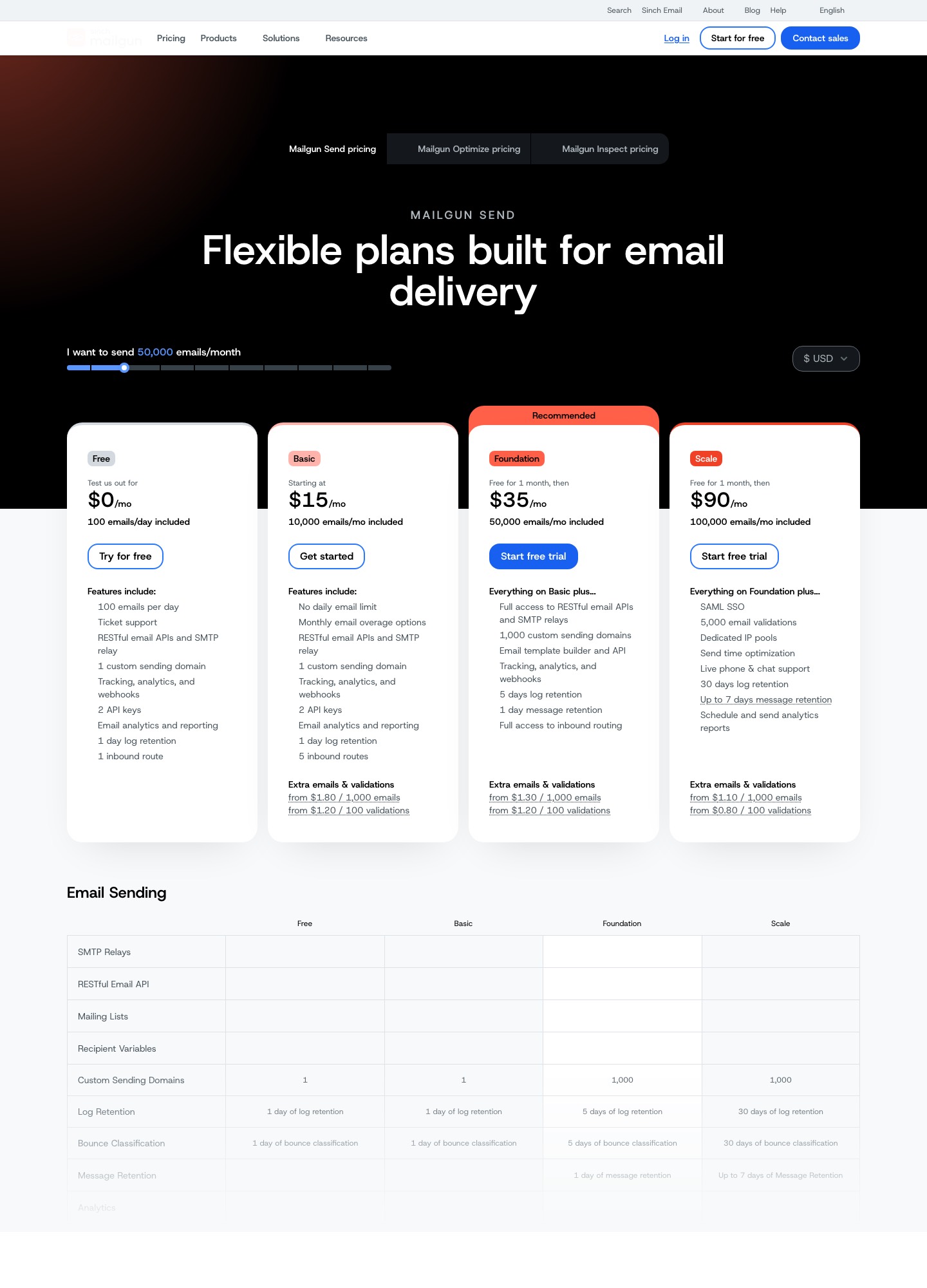
Plan table
| Plan | Monthly price | Included | Notable limit |
|---|---|---|---|
| Free | $0 | 100 emails/day | One custom sending domain; one-day logs |
| Basic | $15 | 10,000 emails/month | Extra from $1.80/1,000 |
| Foundation | $35 | 50,000 emails/month | Extra from $1.30/1,000 |
| Scale | $90 | 100,000 emails/month | 5,000 validations included |
Cost at common volumes
At 1,000 emails, Free can cover the volume if it stays within 100 per day; Basic is still a $15 monthly commitment. At 10,000, Basic is $15 before overages. At 50,000, Foundation is $35. At 100,000, Scale is $90. If a month exceeds its included volume, multiply the overage by the published per-thousand starting rate and confirm the exact invoice in the account.
Mailgun is volume-plan pricing rather than contact pricing. A quiet month does not turn Basic into a $1.50 bill. The plan buys a quota and a set of operational features. Model your peak month, not only the average, and include validation usage if you use Mailgun's validation product.
Free plan reality
Free means 100 emails per day, one custom domain and one day of log retention. That is enough for a small integration or a development environment with controlled traffic. It is a poor fit for a production application that needs a larger burst, long debugging history, or multiple sending domains.
Foundation versus Scale
Foundation is the practical middle tier for an application sending around 50,000 messages monthly. Scale adds four times the volume and includes 5,000 validations, while extending log retention to 30 days and adding SAML SSO. Choose Scale when those controls matter, not simply because the word “enterprise” sounds safer.
Who should choose Mailgun?
Choose Mailgun if your team wants a REST API and SMTP relay plus inbound routing, event logs, validation and dedicated-IP options. It suits engineers who will own DNS, retries, suppression and webhook processing. Choose Amazon SES if raw send cost inside AWS is the priority and you are prepared to assemble more operational pieces. Choose Mailtrap if the first problem is safe staging and email QA rather than production volume.
Migration notes
Export templates, recipient suppression lists and event mappings before switching. Create a separate sending domain, authenticate SPF and DKIM, and send a low-risk class first. Mailgun's event payloads should be mapped to your internal message ID so a retry does not duplicate a receipt. Keep the old provider available until bounces and complaints are flowing into your own system.
Mailgun invoice checklist
Record the included monthly quota and the overage rate next to your expected peak. Basic is not a pay-as-you-go $15 ceiling: it is a 10,000-message allowance with additional usage starting at $1.80 per thousand. Foundation and Scale have different retention windows, so a team that relies on historical event searches should price the operational benefit as well as the messages. Validation consumption should have its own line in the forecast.
Mailgun’s Free plan is best treated as a controlled test lane. The 100-per-day limit is easy to hit during a load test, and one-day logs disappear before a long incident review. Create separate API keys for local development, staging, and production; keep the sending domain for each environment explicit. That discipline matters more than the difference between two paid tiers.
At 75,000 messages, Foundation still covers the allowance and is $35; Scale is $90 with room for 25,000 more messages. If your traffic is seasonal, calculate the annual cost from the busiest month rather than multiplying a quiet month by twelve. A written migration plan should also name the person who owns SPF, DKIM, suppression imports, webhook signature checks, and rollback.
Operational ownership
Mailgun reduces some infrastructure work but does not remove sender responsibility. Your application still needs a durable message ID, idempotent webhook handling, suppression rules, and an escalation path for complaints. The pricing page is the starting point for a quote; your actual total also depends on validation, overage and any dedicated-IP choice.
Ask procurement to save the pricing URL and date with the contract. When a plan changes, compare included volume, log retention, domains, seats, validation and support together. That record makes a future migration a controlled exercise rather than a search through old invoices.
Questions to take to procurement
Ask for the exact allowance, overage, retention, region and support terms in writing. Keep the answer with the date checked so the next editor can reproduce the calculation.
Plan review note
Recheck the public page before renewing because plan labels, quotas and included features can move. Preserve the archived date and arithmetic in your decision record.
FAQ
Does Mailgun have a free plan?
Yes. The listed free plan includes 100 emails per day and a single custom sending domain.
How much is 50,000 emails?
The Foundation plan is $35 per month for 50,000 emails, with extra email pricing starting at $1.30 per 1,000.
Is Mailgun cheaper than SES?
SES has a lower variable send rate. Mailgun's monthly fee pays for more of the delivery workflow, so compare total ownership and incident work.