Amazon SES pricing: cost per email and monthly examples
Amazon SES is priced by email volume rather than contacts or seats. The current pricing page lists Essentials at $0.16 per 1,000 emails, Pro at $0.22 per 1,000, and Enterprise at $0.23 per 1,000 for the 0–10 million email band. At those rates, 10,000 emails cost $1.60 on Essentials, $2.20 on Pro, or $2.30 on Enterprise before any account or regional fees.
Prices checked October 7, 2026. Sources: Amazon SES pricing.
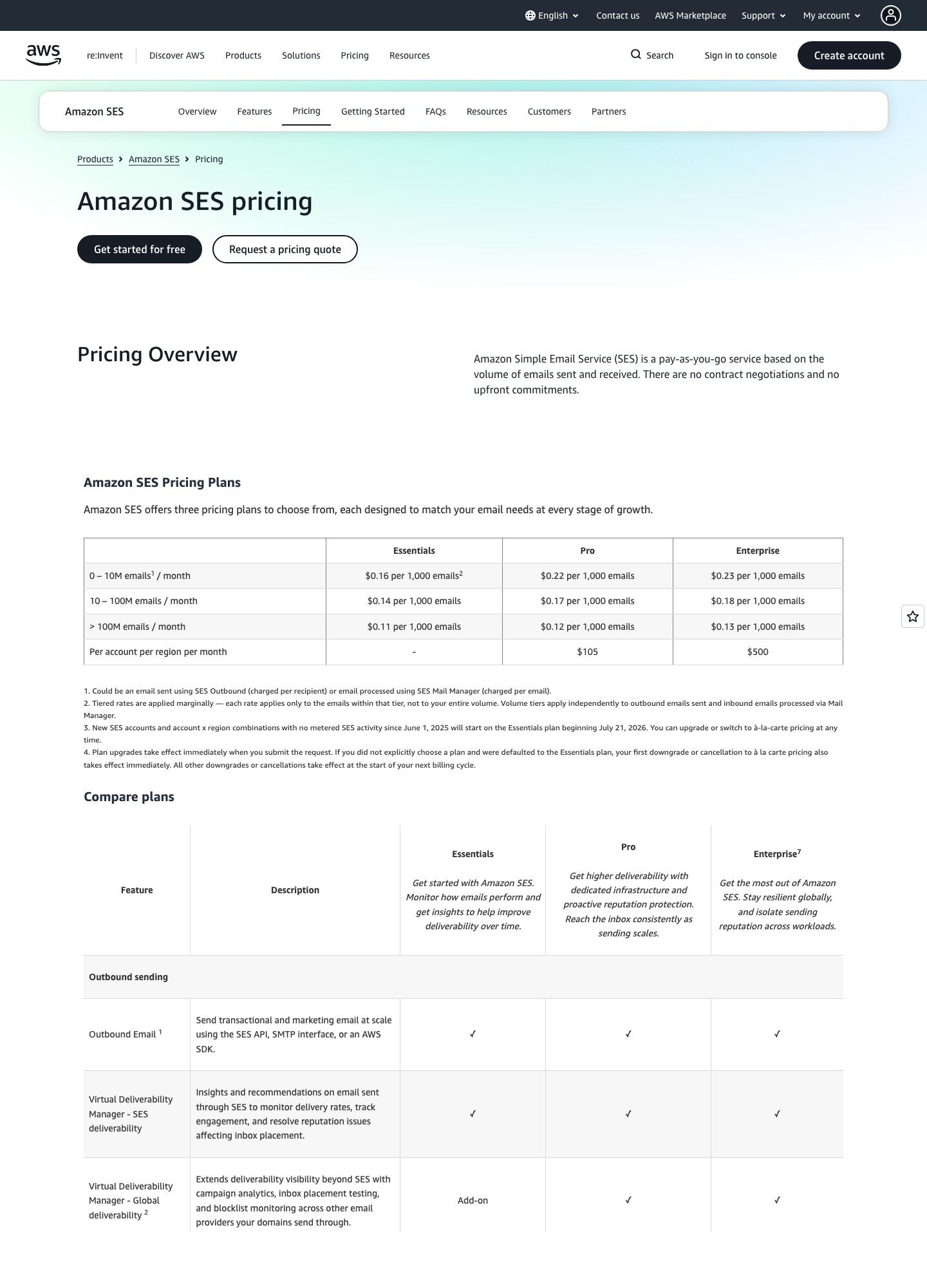
Current plan table
| Plan | Rate | How it bills |
|---|---|---|
| Essentials | $0.16 / 1,000 | Usage based, 0–10M emails/month |
| Pro | $0.22 / 1,000 | Usage based plus $105/account/region/month |
| Enterprise | $0.23 / 1,000 | Usage based plus $500/account/region/month |
Cost arithmetic at real volumes
For 1,000 emails, multiply 1 × the per-thousand rate: $0.16 Essentials, $0.22 Pro, or $0.23 Enterprise. For 10,000, multiply by 10: $1.60, $2.20, or $2.30. For 50,000, multiply by 50: $8.00, $11.00, or $11.50. These figures are deliberately simple because SES is a send-volume service rather than a contact database.
At 100,000 emails the variable part is $16, $22, or $23. Pro then adds the documented $105 per account per region, producing $127 before other AWS charges. Enterprise adds $500, producing $523. That fixed fee changes the break-even conversation: the lowest variable rate is not automatically the lowest invoice when a managed plan fee applies.
Free period and eligibility
Amazon SES's pricing page states that eligible new AWS customers can receive up to $200 in credits and that the free plan is available for six months after account creation. Treat that as a time-limited onboarding benefit, not a permanent 100% discount. Check the AWS account terms before budgeting a long-lived product.
What the number excludes
SES is infrastructure. Your total operating cost can include DNS work, reputation monitoring, bounce and complaint processing, templates, queues, webhooks, CloudWatch, and engineering time. Dedicated IPs are add-ons. If you need message history and a polished incident console without assembling those pieces, compare Amazon SES alternatives such as Mailgun or Mailtrap.
Who should choose each plan
Choose Essentials when your team already owns AWS operations and wants a usage meter with no stated monthly platform fee. Choose Pro when the account-level controls and managed features justify $105 per region each month. Choose Enterprise only when the higher fixed fee and contract conversation match your governance needs; calculate the fixed component separately from send volume.
Migration notes
Moving into SES means verifying identities, publishing SPF and DKIM records, requesting production access, and wiring event destinations for bounces and complaints. Export templates and suppression data from the incumbent first. Keep the old provider available while you replay password resets, invoices, and one failure path against SES, then switch traffic by message class.
AWS-specific budgeting checklist
Separate the SES line item from the rest of the AWS bill. A finance review should record region, account, plan, monthly send volume, dedicated IP decisions, and the owner of reputation alerts. Amazon SES's pricing page lists fixed per-account, per-region amounts for Pro and Enterprise, so a multi-region design multiplies that component. If one region handles receipts and another handles product notifications, model them independently before adding the totals.
Also document whether messages are sent directly through the SES API, through SMTP credentials, or by an application service that wraps SES. The transport affects rotation, retry behavior, and which logs your team can inspect. A cost sheet that says “SES is fractions of a cent” is incomplete unless it names who builds the queue, who handles a complaint, and who responds when the account leaves the sandbox.
For a 250,000-message month, the variable Essentials arithmetic is 250 × $0.16 = $40. Pro is 250 × $0.22 = $55 plus the fixed account fee; Enterprise is 250 × $0.23 = $57.50 plus its fee. Put those equations beside your forecast so a later plan change is visible. Compare that result with a managed provider whose invoice includes logs and support, then choose based on the operating model rather than a headline rate.
Operational ownership
SES pricing should be read together with the work required to operate it. Your queue decides retry timing, your application stores correlation IDs, and your event consumer decides when a bounce becomes a suppression. AWS gives you primitives rather than a finished incident workflow. That is a good trade when your team already runs those systems and a poor trade when the lowest invoice would create a new on-call rotation.
Document region selection, sandbox exit, identity verification, DKIM rotation, configuration sets and event destinations. The checklist belongs in the repository beside the sending code. Review it whenever the account changes plan, region or dedicated-IP configuration.
Questions to take to procurement
Ask for the exact allowance, overage, retention, region and support terms in writing. Keep the answer with the date checked so the next editor can reproduce the calculation.
FAQ
How much does 1,000 emails cost?
$0.16 on Essentials, $0.22 on Pro, or $0.23 on Enterprise for the listed band, before fixed fees and other AWS charges.
Is Amazon SES free?
Eligible new AWS customers can receive credits and a six-month free period. It is not a permanent unlimited free tier.
Is SES cheaper than Mailgun?
At raw volume, SES has a much lower variable rate. Mailgun bundles more operational tooling into monthly plans, so compare engineering ownership as well as the invoice; see our Mailgun alternatives.