Mandrill pricing: block commitments from 25,000 emails
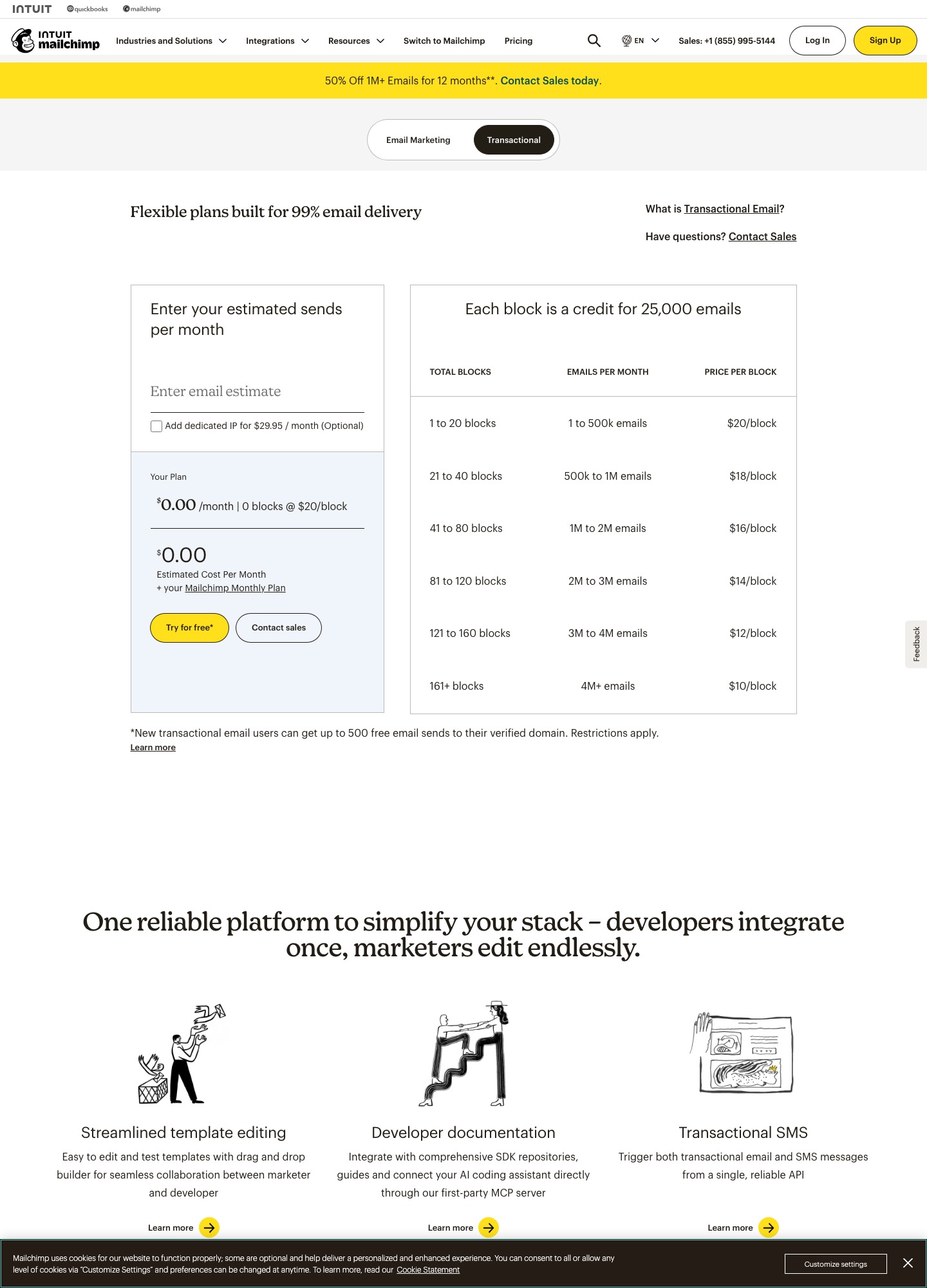
Mandrill sells transactional email in monthly blocks of 25,000 messages. The public price is $20 per block for 1–20 blocks, $18 for 21–40, $16 for 41–80, $14 for 81–120, $12 for 121–160, and $10 for 161 or more. There is no permanent free plan; new users can receive up to 500 free sends to a verified domain under the current offer. I checked the Mandrill pricing page on October 7, 2026.
Block schedule
| Blocks | Monthly range | Price per block | Example base |
|---|---|---|---|
| 1–20 | 25K–500K | $20 | 25K = $20 |
| 21–40 | 500K–1M | $18 | 750K = 30 × $18 = $540 |
| 41–80 | 1M–2M | $16 | 1M = 40 × $20? see note |
| 81–120 | 2M–3M | $14 | Custom band math |
| 121–160 | 3M–4M | $12 | Custom band math |
| 161+ | 4M+ | $10 | Contact Sales may apply |
How to calculate a month
At 25,000 messages, one block costs 1 × $20 = $20. At 250,000, ten blocks cost 10 × $20 = $200. At 500,000, twenty blocks are $400 at the first band. The page describes the next band as 21–40 blocks at $18 each, so 750,000 is 30 × $18 = $540 when the account is billed wholly in that band.
At 1,000,000, the published band is 41–80 blocks at $16 each, which would be 40 × $16 = $640 if the account’s quote applies that rate to the selected block count. Because the pricing page is block-based and band transitions can be contract-sensitive, ask Mandrill to confirm whether the displayed rate is blended or applies to all selected blocks. Do not silently mix the 20-block and 40-block examples into a tiered sum.
At 2,000,000, 80 blocks at the listed $16 rate gives $1,280 under the same assumption. At 4,000,000, 160 blocks at $12 gives $1,920. Above 4 million, Mandrill's pricing page lists $10 per block and notes that high-volume offers may require Sales.
Free-send reality
Mandrill is not a free monthly service. New transactional email users can receive up to 500 free sends to a verified domain, with restrictions. That is an onboarding allowance, not a recurring Free plan, and it cannot be used to model a production month.
Mandrill-specific billing gotchas
The first gotcha is commitment: each block represents 25,000 credits, and unused emails do not roll over. A quiet month can therefore leave paid capacity unused. The second is the rate band: a large increase can move the per-block price, so the quote should state the band, selected blocks, and whether all blocks receive that rate.
Mandrill is connected to the Mailchimp ecosystem. Include account ownership, billing permissions, and the boundary between marketing credits and transactional blocks in your procurement record. A current offer advertises 50% off for 1M-plus monthly email for twelve months to eligible customers; treat that as a time-limited offer requiring Sales confirmation rather than a baseline price.
Who should choose Mandrill?
Choose Mandrill when your team already operates in Mailchimp’s ecosystem and can forecast volume in 25,000-message increments. It is a poor fit for a tiny service that wants flexible pay-as-you-go billing. Compare Postmark for lower-volume transactional plans, SparkPost for a published high-volume ladder, and Amazon SES for usage-led AWS billing.
Migration notes
Map templates, tags, metadata, suppression rules, and webhook events before moving. Verify the Mailchimp account that will own the billing relationship. Start with one event type, preserve your own message ID, and monitor block consumption weekly. Keep rollback credentials until the first full billing cycle confirms that selected blocks and unused-credit behavior match the quote.
Block planning for seasonal traffic
Mandrill rewards a forecast that is expressed in blocks, but seasonal products should not buy the annual average and hope the peak fits. Write the normal month, the launch month, and the quiet month in blocks, then ask Sales how unused credits and band transitions are handled. Keep a purchase approval trail because selecting 80 blocks instead of 40 changes the monthly commitment materially.
For an account connected to Mailchimp, assign one owner for transactional billing and another for marketing audience operations. That separation prevents a campaign decision from quietly changing the block forecast used by the application team.
Renewal note
Because credits do not roll over, review block selection after every seasonal event. Keep the quote, account owner and Mailchimp relationship in the same record so a future operator can explain why a particular band was chosen.
Competitor cost check
Mandrill’s smallest paid quantity is 25,000 messages for $20. For 10,000 messages, Amazon SES Essentials is 10 × $0.16 = $1.60, while Postmark Basic starts at $15 for 10,000. At 50,000, SES is $8.00 and Postmark's slider shows $55 for Basic; Mandrill would require two 25,000 blocks, or 2 × $20 = $40. At 100,000, SES is $16.00 and Mandrill requires four blocks, or $80 at the first band; 100,000 is not a stop on Postmark's slider (its nearest stop, 125,000, reads $115 for Basic), so check Postmark's slider for that volume. Postmark figures are from its pricing page, read October 7, 2026. Those figures make Mandrill’s block commitment the key tradeoff.
What a Mandrill quote does not settle
The public schedule states block prices and the non-rollover rule, but it does not define a dedicated IP, message-retention period, seat model, inbound routing package, or support response for every account. Ask Sales to state each item and whether a high-volume discount changes all selected blocks or only incremental blocks. Annual or contract purchasing is useful when the 25,000-block forecast is stable and the rate band is written into the agreement. Monthly flexibility is better when a seasonal launch could leave credits unused.
FAQ
What is Mandrill’s smallest paid plan?
One block of 25,000 emails at $20 per block is the smallest listed paid quantity.
Do Mandrill credits roll over?
No. Mandrill's pricing page says unused emails do not roll over, so model seasonal peaks carefully.
Is the 500-email offer a free plan?
No. It is a limited offer for new users sending to a verified domain, not a recurring free tier.