Postmark pricing: four plans and what each costs by volume
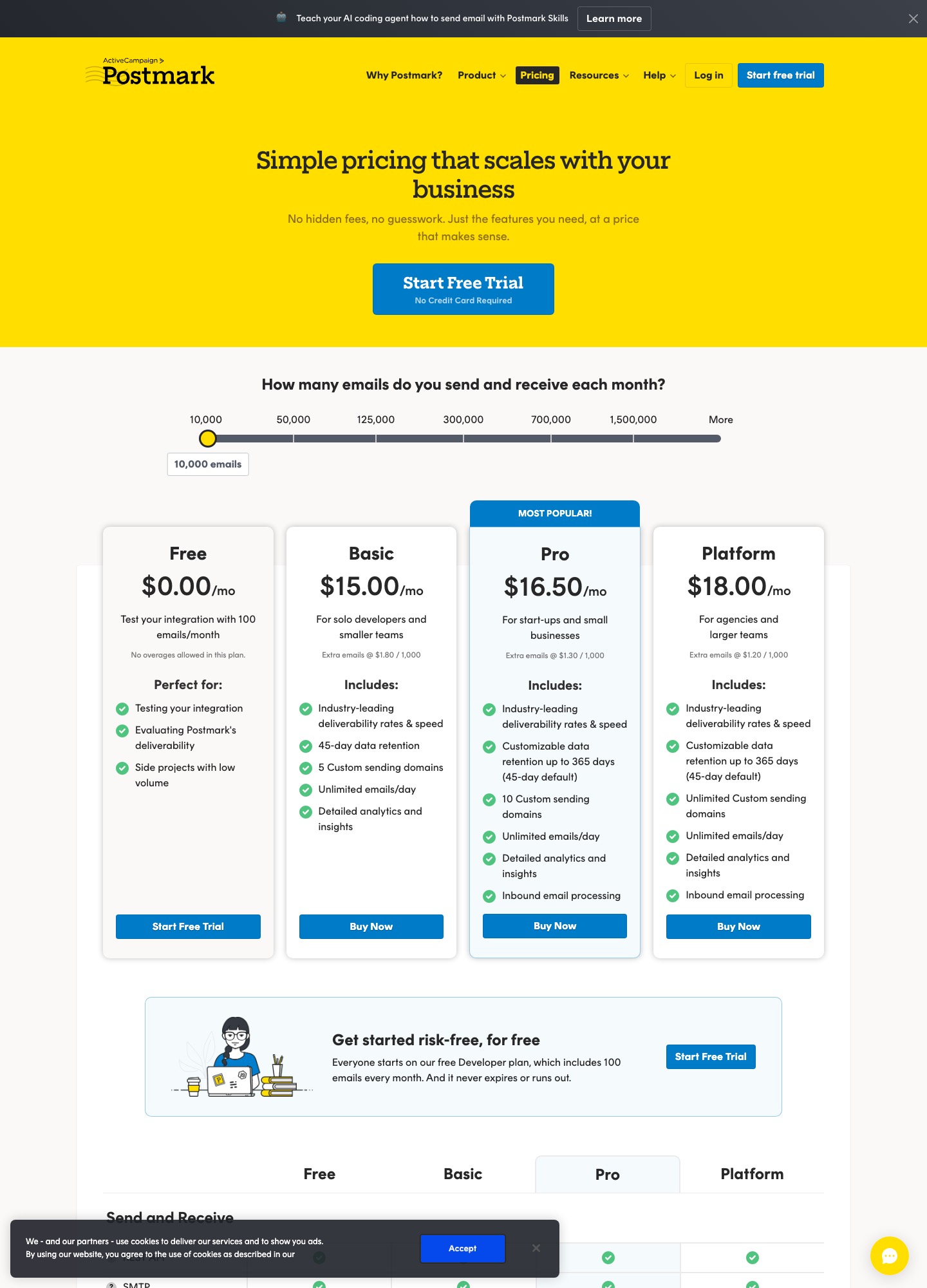
Postmark’s current public plans are Free at $0 for 100 emails a month, Basic at $15, Pro at $16.50, and Platform at $18. The three paid plans start at 10,000 emails per month, with different extra-message rates. I checked these figures on October 7, 2026; the Postmark pricing page is the source. For a switching view, see Postmark alternatives.
Plan comparison
| Plan | Base fee | Included starting volume | Extra email rate |
|---|---|---|---|
| Free | $0 | 100/month | Not allowed |
| Basic | $15/month | 10,000/month | $1.80/1,000 |
| Pro | $16.50/month | 10,000/month | $1.30/1,000 |
| Platform | $18/month | 10,000/month | $1.20/1,000 |
What common volumes cost
Free can send 100 messages in a month for $0, but there is no paid-style cushion. At 1,000 messages, move to a paid plan: Basic is $15, Pro $16.50, and Platform $18 because each starts with a 10,000-message allowance. At exactly 10,000, those same base prices cover the month.
Above 10,000, Postmark's pricing page uses a volume slider, and its stops are 10,000, 50,000, 125,000 and 300,000 emails a month. Read on October 7, 2026, the slider shows Basic at $15 for 10,000, $55 for 50,000 and $115 for 125,000. Pro reads $16.50, $60.50 and $126.50 at the same three stops, and Platform reads $18, $66 and $138. Basic is the cheapest of the three at every stop; the dearer plans buy features, not a lower bill (see below).
Do not rebuild these numbers from the "Extra emails" rate on each plan card. Basic's $1.80 per 1,000 applied to the 40,000 emails between 10,000 and 50,000 would give $87, but the slider's 50,000 stop is $55. Volumes that are not slider stops, such as 20,000 or 100,000, have no price on that page that I read, so for those, check Postmark's slider instead of estimating. For 300,000 and above, read the slider as well; I did not record those figures.
Free plan reality
Free is a test lane for a verified integration. Its 100-message ceiling is quickly reached by password-reset retries or a staging script, and Postmark does not let you buy overage on that tier. Treat it as a smoke-test account, not as a production safety net.
How the tiers differ
Basic is the lowest price at every volume the slider shows, so it is the default for a small team that mainly needs reliable sending and its 45 days of activity history. Pro costs $1.50 more at 10,000 and $5.50 more at 50,000; Postmark's pricing page lists customizable data retention up to 365 days (45 days by default) on the higher plans, and managed dedicated IPs are open only to customers sending 300,000 emails a month or more on Pro or higher. Platform is $3 above Basic at 10,000, $11 above at 50,000 and $23 above at 125,000, and carries the lowest listed extra-email rate ($1.20 per 1,000). Pick Pro or Platform for a feature you need, not because you expect a lower bill.
Postmark is often chosen for transactional stream discipline. Keep that benefit in the operating model: if you would otherwise build message separation, searchable history, and incident workflows yourself, a few dollars of plan difference may be less important than the time saved during a failed notification.
Billing gotchas
Do not read “starting at 10,000” as a pay-as-you-go minimum of ten thousand individual sends on Free. The paid plans carry a monthly base and then add overage. Free has no overage path. Compare Basic, Pro, and Platform at the slider stops nearest your volume (10,000, 50,000 or 125,000), not only their headline fees.
Also record which message stream is being billed. A team with separate product and broadcast traffic should keep those paths distinct in its own ledger, so a marketing import does not make a transactional forecast look like an application spike.
Who should pick Postmark?
Choose Postmark when delivery history and focused transactional sending are central to incident response. Choose Basic for a small, predictable workload. Choose Pro when you want retention beyond 45 days or expect to qualify for a dedicated IP. Choose Platform when multiple teams or client workspaces justify the higher fee ($66 against Basic's $55 at 50,000) and you want the lowest listed extra-email rate among these plans.
For an API-first alternative with a larger free allowance, compare Resend. For AWS-native usage billing, see Amazon SES; for a broader developer diagnostics stack, review Mailgun.
Migration notes
Inventory message streams, templates, sender signatures, suppression rules, and webhook consumers. Add Postmark’s server and message-stream identifiers to your internal message record before cutover. Authenticate a subdomain, route a low-risk receipt class first, and verify that bounce and complaint events map back to the same internal ID. Keep rollback credentials active until both normal sends and failure paths have been observed.
Budgeting beyond the headline fee
Postmark’s base price is only one line in a transactional mail budget. Count the engineering time to preserve stream separation, the storage cost of your own event archive, and the support coverage needed for a failed password reset. If you choose Platform ($66 at 50,000 against Basic's $55), record the operational reason beside the price; otherwise a future renewal may downgrade the plan without noticing the incident-response trade-off.
A good forecast has three rows: quiet month, normal peak, and incident month. For each, write total messages, overage units, plan, and owner. That simple ledger prevents a 10,000-message starting allowance from being mistaken for a hard monthly cap.
Renewal note
Keep a small worksheet with message volume, stream count, base fee, overage units, and the owner for each webhook. That record is more useful than a remembered headline price when the next invoice arrives.
FAQ
Does Postmark have a free plan?
Yes. Free is $0 for 100 emails per month. It does not allow overage, so extra traffic must move to a paid plan.
Which Postmark plan is cheapest at 50,000?
Basic. Postmark's slider shows $55 for Basic, $60.50 for Pro and $66 for Platform at 50,000 emails a month (read October 7, 2026). The same order holds at 10,000 ($15, $16.50, $18) and 125,000 ($115, $126.50, $138).
Why would I pay more for Pro or Platform if Basic is cheaper?
For what the plan includes rather than the send price. Postmark lists retention that can be extended up to 365 days on the higher plans, dedicated IPs only for Pro or higher at 300,000 emails a month or more, and a lower extra-email rate ($1.30 on Pro, $1.20 on Platform, against $1.80 on Basic).