Postmark alternatives for a deliberate switch
Postmark is a focused transactional service, so teams rarely leave because they want a generic “better” provider. The usual trigger is a mismatch: the 100-email Free plan is too small for a real pilot, the account needs an API and SMTP combination, the program has moved into a broader campaign stack, or volume economics no longer fit. Postmark’s current fees are summarized on the Postmark pricing page; this page concentrates on the decision to switch.
Specific reasons teams move on
- Small test allowance: Free is 100 emails per month and does not permit overage, so a staging environment can outgrow it immediately.
- Broader channel needs: a team may need campaigns, SMS, or collaborative template workflows beside transactional streams.
- Protocol mismatch: a legacy estate may be SMTP-first while the new application expects one API and one event model.
- Volume economics: Basic, Pro and Platform have different overage rates, and a high-volume service may be cheaper or more predictable elsewhere.
- Cloud ownership: an AWS team may prefer to keep IAM, regions and monitoring in its existing control plane.
Shortlist and switch-if guidance
| Candidate | Switch if… | Migration effort |
|---|---|---|
| Resend | You want a developer-first API with a larger Free allowance and simple paid tiers. | Medium: map message events, domains, templates and webhook signatures. |
| Mailgun | You need SMTP, inbound routes, validation and detailed event tooling in one account. | Medium-high: translate streams and operational event payloads. |
| Amazon SES | You already operate AWS controls and accept owning more delivery operations. | High: build the dashboards, suppression flow and retry policy around SES. |
| MailerSend | You need templates, API access and team seats in one approachable workspace. | Medium: recreate templates, variables, domains and permissions. |
| SMTP2GO | Preserving an SMTP integration matters more than adopting a new API. | Low-medium: rotate relay credentials and add correlation headers. |
Cost at three monthly volumes
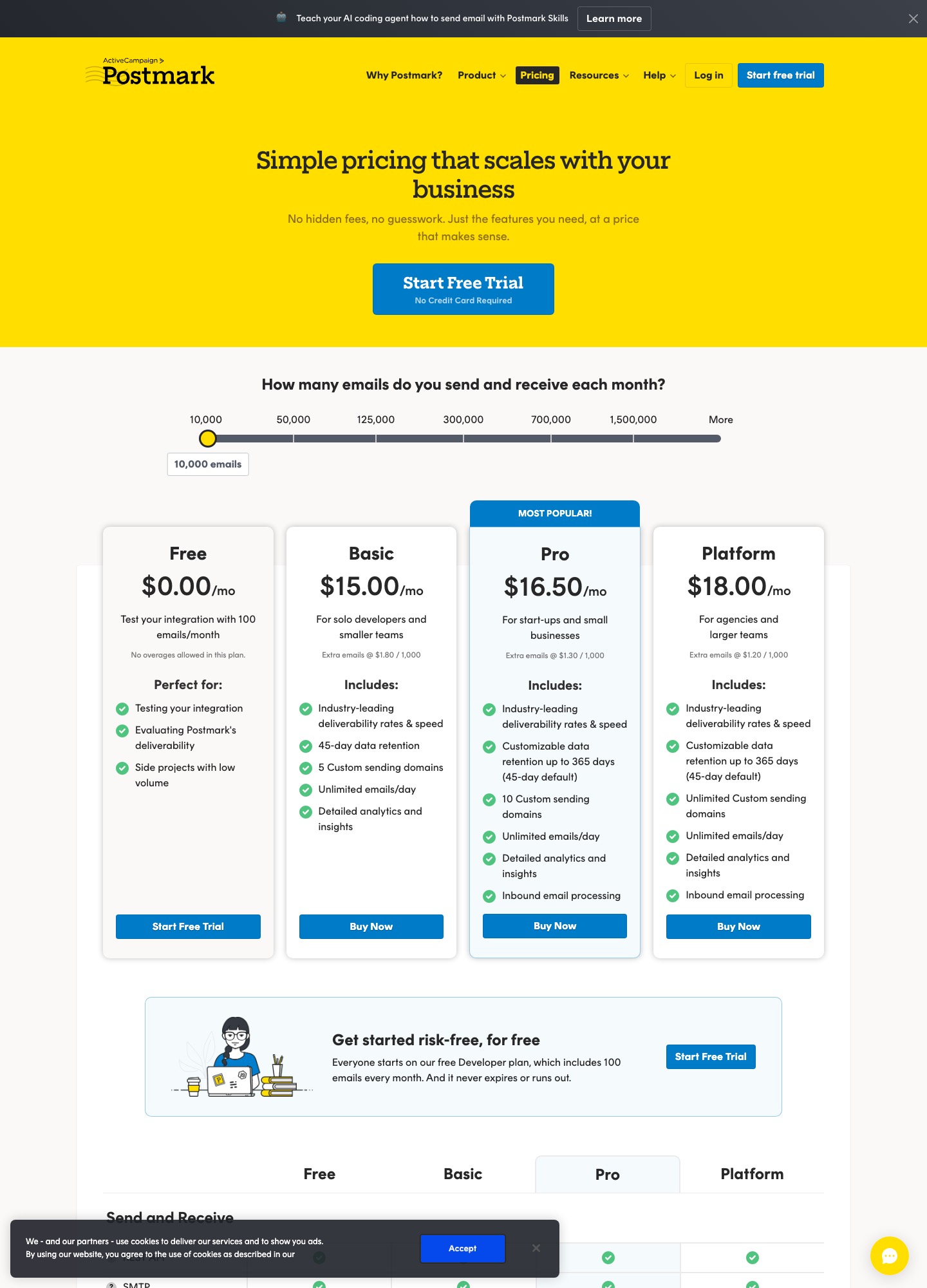
Resend is $20 for 50,000 and $90 for 100,000; its Free allowance does not reach 10,000. Mailgun lists $15 Basic for 10,000, $35 Foundation for 50,000, and $90 Scale for 100,000. Amazon SES Essentials is 10 × $0.16 = $1.60, 50 × $0.16 = $8, and 100 × $0.16 = $16. MailerSend lists $31.50 for 50,000, with no 10,000 or 100,000 tier on its plan cards. SMTP2GO is $15 at 10,000; its $1.20 per extra thousand makes 50,000 $63, and its Professional plan lists 100,000 emails for $75 on SMTP2GO's pricing page. Postmark itself is priced from a slider with stops at 10,000, 50,000, 125,000 and 300,000 emails. On October 7, 2026 Basic read $15, $55 and $115 at the first three, Pro $16.50, $60.50 and $126.50, and Platform $18, $66 and $138. 100,000 is not a stop, so for that volume check Postmark's slider; the $1.80 overage rate on the Basic card does not reproduce the slider.
| Candidate | 10,000 | 50,000 | 100,000 |
|---|---|---|---|
| Resend | Not covered by Free | $20 | $90 |
| Mailgun | $15 | $35 | $90 |
| Amazon SES | $1.60 | $8 | $16 |
| MailerSend | Not published | $31.50 | Not published |
| SMTP2GO (Starter, then Professional at 100,000) | $15 | $63 | $75 |
Operational differences from Postmark
Resend offers a small API surface and paid webhooks, but teams must map Postmark streams and message history into its event model.
Mailgun adds SMTP relay, inbound routes, validation, and event logs, so it is useful when receiving mail or diagnosing delivery is part of the same account.
Amazon SES uses AWS identity and regional controls. It can reduce send cost while moving suppression, dashboards, retries, and reputation work to the customer.
MailerSend combines API and SMTP with collaborative template seats and domain allowances; that account shape differs from Postmark’s focused stream workflow.
SMTP2GO is relay-first and keeps the protocol change small. Its daily cap and overage rate should be tested against the existing Postmark traffic pattern.
Fit by operating model
Choose Resend when engineers own the integration and want a small API surface. Choose Mailgun when inbound processing and diagnostic controls are part of the product. Choose SES when platform engineers already maintain AWS identity and monitoring. Choose MailerSend when non-engineers need a shared template workspace. Choose SMTP2GO when the lowest-risk migration is a relay credential change.
Keep Postmark when its focused stream model is exactly what protects your product mail from marketing traffic. A switch should solve a named constraint, not remove a workflow your incident team depends on.
Migration work in detail
Message and template inventory
Export every template, layout, variable, sender signature, stream, tag and metadata field. Identify which messages are time-sensitive and which can tolerate a temporary dual-send. Build a provider-neutral fixture for each critical message so rendering changes are visible.
Event and suppression mapping
Map Postmark delivery, bounce, spam complaint and open events to your own schema. Preserve the internal message ID when adapting to a candidate’s webhook payload. Import suppression decisions deliberately; never assume a new provider has the same list or retention behavior.
DNS and rollout
Authenticate a new subdomain with SPF, DKIM and DMARC alignment. Send a low-risk class first, then receipts, then authentication messages. Watch complaint and bounce alerts through a full traffic cycle. Keep Postmark credentials ready for rollback until the new provider has passed the failure drills.
Pricing in context
Postmark’s $0 Free, $15 Basic, $16.50 Pro and $18 Platform prices are covered in the linked pricing analysis. Use that page, and Postmark's own slider, to read your volume before deciding that a different provider is cheaper; this guide intentionally keeps the focus on switching effort and fit.
Decision checklist
- Write the operational constraint in one sentence.
- Choose two candidates whose “switch if” condition is true.
- Run duplicate, delayed, bounce and complaint tests.
- Compare plan, overage, seats, logs, support and migration labor.
- Document rollback, DNS ownership and the person responsible for webhooks.
Those price points also illustrate why the reason to switch should be explicit. A team leaving because Free is too small has a different shortlist from a team leaving because Postmark's $55 at 50,000 emails is more than it wants to pay. Put the constraint in the procurement ticket before collecting demos, and keep the rollback owner named.
FAQ
Is Resend an easy Postmark replacement?
It can be for an API-owned application, but event and suppression fields still need an adapter and verification.
Should an AWS team switch to SES?
SES can fit an AWS-native operating model. The team must accept ownership of more surrounding delivery controls.
What is the least disruptive alternative?
SMTP2GO is often least disruptive for an SMTP estate. For an API rewrite, the answer depends on how much of Postmark’s stream model your application uses.