Mailtrap alternatives for production sending
Mailtrap's Email API/SMTP plans are some of the cheapest in this market: $15 for 10,000 emails, $20 for 50,000 and $30 for 100,000. Price is rarely why people leave. The Basic plan keeps logs for five days and allows three users and five domains, the dedicated IP only arrives with the $85 Business plan, and the monthly quota counts inbound mail as well as outbound. If one of those is your blocker, SparkPost, Amazon SES, SMTP2GO, Resend, Postmark and Mailgun each remove a different one, and the cost table below shows what the switch does to your bill from 10,000 to 250,000 emails a month.
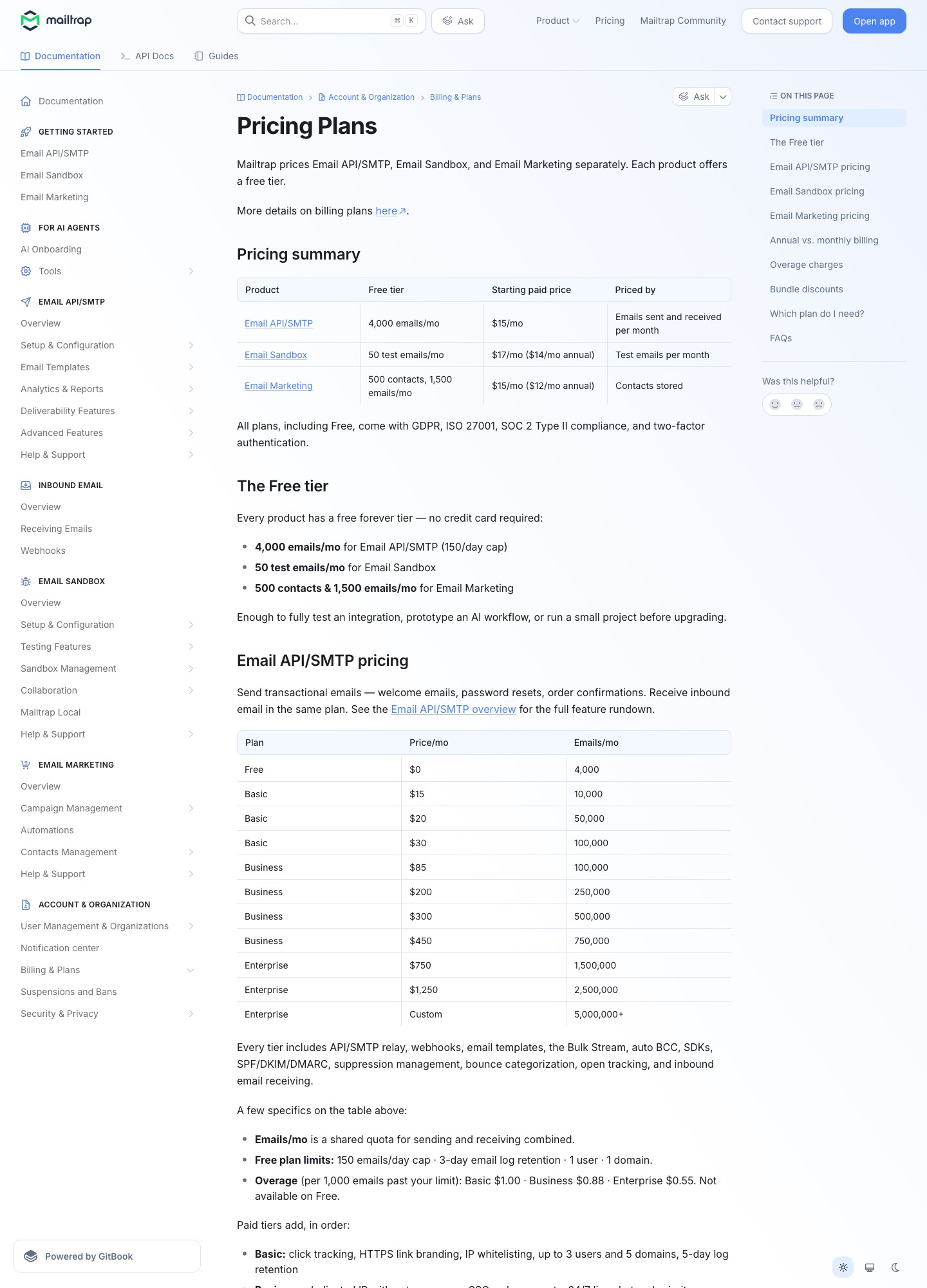
What each Mailtrap plan limits
| Plan | Price and volume | Log retention | Users / domains | Overage per 1,000 |
|---|---|---|---|---|
| Free | $0, 4,000 emails (150 a day) | 3 days | 1 / 1 | Not available |
| Basic | $15 for 10,000, $20 for 50,000, $30 for 100,000 | 5 days | up to 3 / 5 | $1.00 |
| Business | $85 for 100,000, $200 for 250,000, $300 for 500,000, $450 for 750,000 | 15 days | up to 100 / 100 | $0.88 |
| Enterprise | $750 for 1,500,000, $1,250 for 2,500,000 | 30 days | unlimited | $0.55 |
The figures come from Mailtrap's billing plans documentation. The page also says every tier includes API and SMTP relay, webhooks, templates, suppression management and bounce categorization, so the plans differ in limits and support, not in basic capability.
Why teams outgrow it
Five days of logs is short for a support queue
A customer writes in on Monday about a receipt that never arrived on the previous Wednesday. On Basic, the delivery log for that message is already gone. Business stretches retention to 15 days and Enterprise to 30, but that is a jump from $30 to $85 at 100,000 emails. If the log window is the real complaint, compare it with SparkPost, whose pricing page states 30-day retention on every plan, and SMTP2GO, whose Starter plan lists 30 days of reporting.
The dedicated IP costs $55 more at the same volume
At 100,000 emails a month, Basic is $30 and Business is $85. The extra $55 buys a dedicated IP with automatic warm-up, SSO, sub-accounts, 24/7 chat support and the longer log window. A sender that wants only the IP is paying for a bundle. SMTP2GO's Professional plan is $75 for 100,000 emails and lists a dedicated IP address. SparkPost's Growth plan is $80 for 100K, with dedicated IPs as a $24.95 monthly add-on per address, so one IP brings it to $104.95. Mailgun's Scale plan at $90 includes dedicated IP pools.
Inbound mail eats the same quota
Mailtrap says its emails-per-month figure is "a shared quota for sending and receiving combined", and every plan includes inbound addresses and webhooks. An application that parses 20,000 replies a month and sends 35,000 notifications is a 55,000-email account, which tips it out of the 50,000 Basic step and into the next. Receiving mail somewhere else, or on a provider that does not count it against sending, changes which tier you land on.
The free tier is capped per day
The Free plan gives 4,000 emails a month, but a cap of 150 a day applies. A launch announcement to 1,000 users is fine; a nightly job that sends 300 digests is not. Resend's free plan has the opposite shape for this case, at 3,000 emails a month with a limit of 100 a day, so neither is a fix for burst traffic. Only a paid plan removes it.
Testing and sending are billed as separate products
Mailtrap prices Email API/SMTP, Email Sandbox and Email Marketing separately, each with its own free tier. The Sandbox free tier is 50 test emails a month, and paid Sandbox starts at $17 a month ($14 billed annually). That cuts both ways: you can keep the Sandbox as your staging inbox and move only production sending, without cancelling the whole account.
Monthly cost at 10,000, 50,000, 100,000 and 250,000 emails
| Provider | 10,000 | 50,000 | 100,000 | 250,000 |
|---|---|---|---|---|
| Mailtrap | $15 | $20 | $30 (Basic) or $85 (Business) | $200 |
| SparkPost | $15 (Startup, 50K allowance) | $15 | $30 | $175 (Growth) |
| Amazon SES | $1.60 | $8 | $16 | $40 |
| SMTP2GO | $15 | $63 | $75 (Professional) | $202.50 |
| Resend | $20 | $20 | $90 | $225 |
| Postmark Basic | $15 | $55 | Not a slider stop ($115 at 125,000) | Not a slider stop; check Postmark's slider |
| Mailgun | $15 | $35 | $90 | $255 |
How the figures were built: SparkPost lists a 50K step at $15 and a 100K step at $30 on Startup, and 250K at $175 on Growth. SES charges $0.16 per 1,000. SMTP2GO Starter adds $1.20 per extra thousand, so 50,000 is 15 + 40 × $1.20 = $63, while Professional's 100,000 is $75 plus $0.85 per extra thousand, so 250,000 is 75 + 150 × $0.85 = $202.50. Resend's Scale plan is $90 for 100,000 with $0.90 per extra thousand, so 250,000 is 90 + 150 × $0.90 = $225. Postmark Basic is read from a slider on its pricing page with stops at 10,000, 50,000, 125,000 and 300,000 emails; it showed $15, $55 and $115 for the first three on October 7, 2026, so 100,000 and 250,000 have no figure here. Mailgun's 250,000 figure takes Scale's $90 plus 150 × $1.10, using the lowest overage rate it lists, so treat it as a floor.
On price alone Mailtrap wins at 50,000 and is close to SparkPost and SES elsewhere. You only save money by leaving for SES, and SES gives you the least built-in tooling of the group.
Which alternative fixes which limit
SparkPost answers the log and domain limits at lower cost: 30-day retention on every plan, 10 sending domains on Startup and a $15 entry price. Its free plan is only 1,000 emails a month with a 50-a-day cap, and the pricing page is now branded Bird. See the SparkPost pricing guide.
Amazon SES is the answer when the bill is the problem and you are comfortable owning the dashboards. It also has an inbound processing feature, Mail Manager, if you want to move receiving out of Mailtrap's quota. Details are on the SES pricing page.
SMTP2GO is the cleaner fix for the dedicated IP gap: the Professional plan is $75 for 100,000 emails and lists a dedicated IP and email testing tools. Its free plan, at 1,000 emails a month and 200 a day, is smaller than Mailtrap's. There is more on the SMTP2GO pricing page.
Resend suits a small team on a TypeScript stack that wants one $20 plan for up to 50,000 emails and three domains on the free tier. Postmark costs more per message than most of this list at 50,000 emails ($55 on Basic against Mailtrap's $20) and takes the most operational work off your hands; see Postmark pricing for the stream model. Mailgun adds inbound routing and a 1,000-domain allowance from Foundation at $35, which is the better route if you manage many customer domains.
Moving production mail off Mailtrap
Export suppression data first
Mailtrap lists suppression management and bounce categorization on every plan. The new provider starts with an empty suppression list, so a hard-bounced address you stopped mailing last month becomes mailable again on day one. Export hard bounces, unsubscribes and complaints before you switch the sender, and import them where the new provider supports it.
Keep the old DNS records until the log window has passed
Publish the new provider's SPF and DKIM records on a fresh sending subdomain and send a small share of traffic through it first. Leave Mailtrap's records untouched for at least the length of your retention period; with five days of logs on Basic, that is the only window in which you can still investigate a bounce from the old route.
Check which templates and streams you actually use
Mailtrap's plans include email templates and a Bulk Stream. If your code sends by template ID, the template's HTML and variables must live in your repository or in the new provider's store before cutover. If you route bulk mail through the Bulk Stream, find the matching separation on the new provider rather than mixing it into transactional traffic.
Replace inbound addresses and the new-email webhook
Every Mailtrap plan comes with a dedicated receiving address, parsed messages through the API and real-time webhooks for new mail. If anything in your product reads replies, the replacement has to receive mail as well. Mailgun and Amazon SES list inbound handling; check the others before you commit.
Related pages
For head-to-head views, see Resend vs Postmark, Postmark vs Mailgun and Resend vs Mailgun, and the Mailgun pricing page.
FAQ
Can I keep Mailtrap Sandbox and move only sending?
Yes. Mailtrap prices Email API/SMTP and Email Sandbox as separate products, each with a free tier, so you can leave the Email API plan and keep the Sandbox as a staging inbox.
Is Mailtrap too expensive for production sending?
Not usually. At $20 for 50,000 and $30 for 100,000 it undercuts Mailgun, Resend, SMTP2GO and Postmark. The reasons to leave are retention, user and domain caps, and the dedicated IP.
What is the cheapest way to get a dedicated IP?
For 100,000 emails a month, SMTP2GO Professional at $75 is below Mailtrap Business at $85 and Mailgun Scale at $90. SparkPost with one add-on IP comes to $104.95.