Mandrill alternatives for teams that only want transactional email
Mandrill, now sold as Mailchimp Transactional Email, charges $20 for each block of 25,000 emails and requires a Mailchimp account underneath it. That structure is the whole case for leaving: you pay for a full block even if you send 10,000, nothing rolls over, sending stops when the blocks run out, and the Mailchimp plan is billed in addition. Amazon SES, Mailtrap, SMTP2GO, Resend, Postmark and SendGrid all price transactional mail on its own. Mandrill's per-block price is actually competitive at 100,000 emails and above, so this page is as much about when to stay as when to go.
The pricing rules that cause the friction
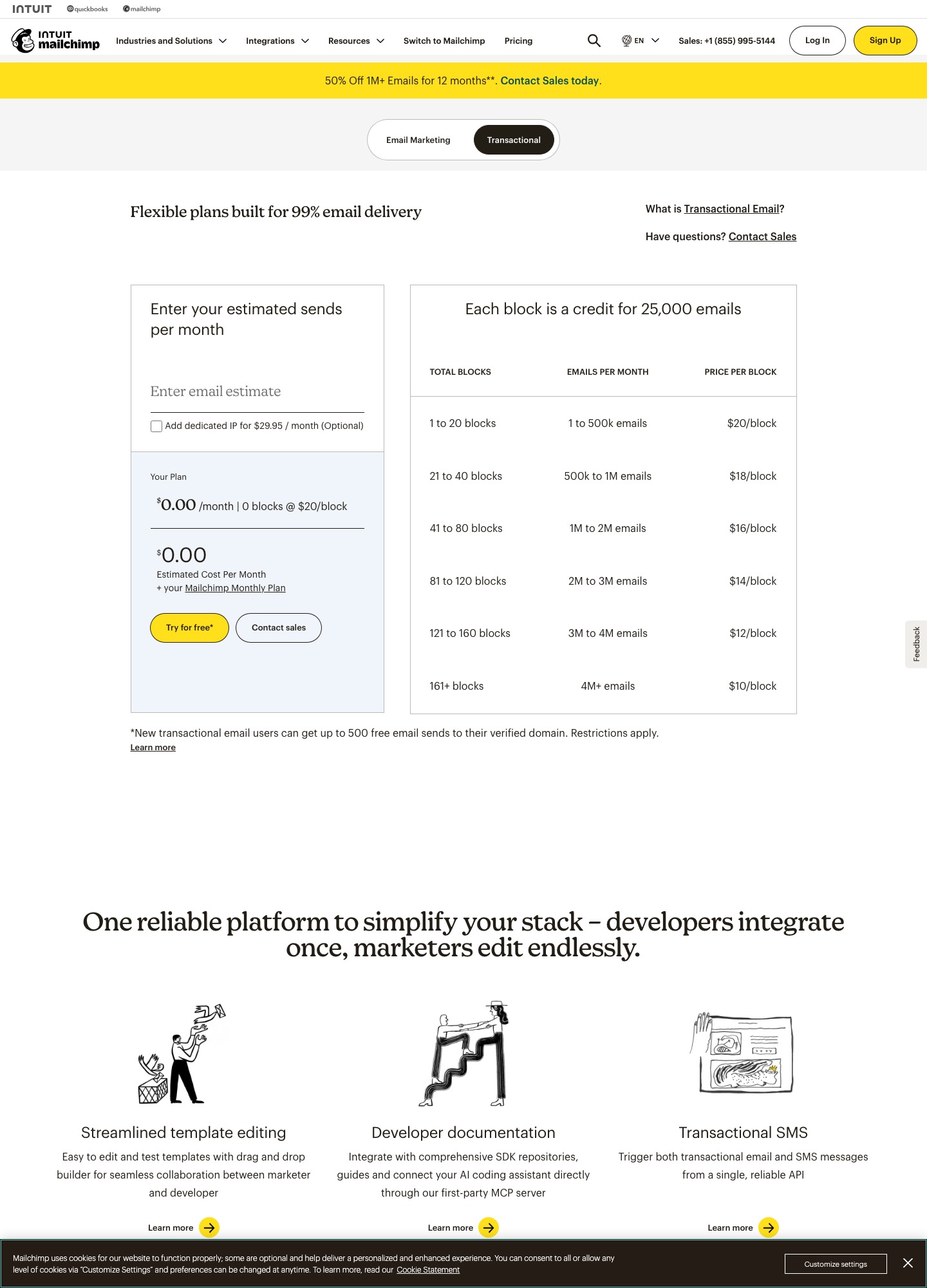
Each block is a credit for 25,000 emails and costs $20 up to 20 blocks (500,000 emails a month), falling to $18 for blocks 21 to 40 and lower after that; the full schedule is on our Mandrill pricing page. Mandrill's pricing page says unused emails in a block do not roll over, that the system stops sending when you run out of blocks, and that you can either set automatic block purchases or ask for an alert as you approach the limit. A dedicated IP is an optional $29.95 a month. There is no ongoing free plan, only a promise of up to 500 free sends to a verified domain for new users, with restrictions.
Reasons people leave
You need a Mailchimp account to use it
The FAQ states plainly that a Mailchimp account is required, and that Transactional Email is an add-on to Mailchimp's Standard and Premium plans or the legacy Monthly plan. The calculator on the page ends with "+ your Mailchimp Monthly Plan". Mailchimp's own pricing page lists Standard from $20 a month at its 500-contact selector, so a team that does not use Mailchimp for newsletters is looking at a floor of about $40 a month ($20 for one block plus $20 for the plan) before sending a single message. Access, billing and platform features all sit behind that account.
Blocks are a coarse unit
A product that sends 8,000 messages a month still pays $20, which is $2.50 per thousand. A product that sends 26,000 buys two blocks and pays $40, which is $1.54 per thousand. The blocks suit steady volume. They are awkward for a young product with a growing list or a seasonal one with a peak month, because the next step up is a full $20.
Running out means stopping
Mandrill calculates transactional sends in real time and stops delivering when blocks are exhausted unless auto-purchase is on. For password resets, that is an outage rather than a bill. Providers that bill overage per thousand, such as SMTP2GO at $1.20 per extra thousand on Starter, keep sending and charge afterwards.
The free path is thin
Five hundred demo sends do not cover a staging environment plus a pilot. Alternatives with a standing free plan include Resend at 3,000 emails a month and Mailtrap at 4,000 emails a month, both with daily caps.
Cost at 10,000, 25,000, 100,000 and 500,000 emails
| Provider | 10,000 | 25,000 | 100,000 | 500,000 |
|---|---|---|---|---|
| Mandrill (plus Mailchimp plan) | $20 | $20 | $80 | $400 |
| Amazon SES | $1.60 | $4 | $16 | $80 |
| Mailtrap | $15 | $20 | $30 | $300 (Business) |
| SMTP2GO | $15 | $33 | $75 | $415 |
| Resend | $20 | $20 | $90 | $450 |
| Postmark Basic | $15 | Not a slider stop | Not a slider stop ($115 at 125,000) | Not a slider stop |
The arithmetic: Mandrill is four blocks at $20 for 100,000 and twenty blocks for 500,000. SES is $0.16 per 1,000. Mailtrap's ladder lists $15 for 10,000, $20 for 50,000, $30 for 100,000 and $300 for 500,000 on Business. SMTP2GO's Starter adds $1.20 per extra thousand (15 + 15 × $1.20 = $33 at 25,000), and its $75 Professional plan covers 100,000 with $0.85 per extra thousand, which gives 75 + 400 × $0.85 = $415 at 500,000. Resend's Scale plan is $90 for 100,000 plus $0.90 per extra thousand. Postmark Basic is priced from a slider on its pricing page whose stops are 10,000, 50,000, 125,000 and 300,000 emails; on October 7, 2026 Basic read $15, $55 and $115 for the first three. 25,000, 100,000 and 500,000 are not stops, so those cells give no figure; read your own volume off the slider instead of computing it from the $1.80 overage rate.
Mandrill therefore beats Resend on paper at 100,000 and 500,000 emails. Against Postmark it comes out ahead at the nearest stop above 100,000: five blocks at $20 is $100 for 125,000 emails, against $115 on Basic. Mandrill loses to Mailtrap and SES at every volume above except a tie with Mailtrap at 25,000, and only looks bad at low volume once the Mailchimp plan is counted. Mandrill also advertises 50% off for the first twelve months for new customers at 1,000,000 emails or more, but the offer is limited to eligible new customers and handled through sales.
Where to go
Amazon SES is the volume floor and the choice if you can build suppression handling, dashboards and bounce processing yourself. See the SES pricing guide. Mailtrap has the smoothest ladder of the list, from $15 to $30 across 10,000 to 100,000 emails, with logs kept for five days on Basic and 15 on Business. SMTP2GO bills overage instead of stopping and includes a dedicated IP on the $75 Professional plan; the SMTP2GO pricing page has the tiers.
Resend is the smallest move for a modern JavaScript team and gives you a free plan for the pilot. Postmark costs more per message than SES, Mailtrap or Resend at the volumes where its slider has a stop, and is the right choice when message-level support is worth paying for; the Postmark pricing page explains its streams. SendGrid covers API, SMTP and templates under one roof, with Essentials from $19.95 a month and Pro from $89.95, and its own marketing product alongside; our SendGrid page covers the catch.
If you run a SaaS
If Mailchimp is still on the invoice only because Mandrill needs it, and your product sends billing and lifecycle messages as well as receipts, Sequenzy is one option to price. Its pricing page lists 2,500 emails free and $19 a month for 15,000 with unlimited contacts. Weigh it against the transactional specialists above.
Switching away from Mandrill
Time the cutover to your block cycle
Because unused emails do not roll over, the cheapest moment to switch is just after a block purchase date. Turn off automatic block purchases before the cutover and remove the stored card only after the last in-flight message has been delivered.
Authentication and IP reputation
Publish the new provider's SPF and DKIM records on a fresh subdomain and ramp traffic. If you pay $29.95 a month for a Mandrill dedicated IP, remember that its reputation does not move: a new dedicated IP needs its own warm-up, and a shared pool on the new provider is the safer first month.
Templates, SMS and shared credits
Mandrill markets drag-and-drop template editing so that marketers and developers share templates. Replacing that means either keeping templates in your repository or choosing a provider with a hosted editor. If you use transactional SMS, note that Mandrill's SMS credits are shared with Mailchimp's SMS marketing credits and are bought through a Mailchimp add-on; that function has to be rebuilt separately.
FAQ
Can I use Mandrill without Mailchimp?
No. Mandrill's FAQ says a Mailchimp account or plan is required for access and billing. A new user can try a limited demo of up to 500 sends first.
Is Mandrill cheaper than Postmark?
Around 100,000 emails a month, yes, narrowly: Postmark's slider has no 100,000 stop, but at 125,000 Basic reads $115 against $100 for five Mandrill blocks, and Mandrill is $80 for four blocks at 100,000. At 50,000, Basic's $55 is above Mandrill's $40 for two blocks. At 10,000, Postmark Basic is $15 against Mandrill's $20 block, before the Mailchimp plan.
What happens when I run out of blocks?
Sending stops unless automatic block purchase is switched on. Mandrill offers an alert as an alternative.