SMTP2GO alternatives for mid-volume senders
SMTP2GO is easy to understand: a free plan, a $15 Starter plan for 10,000 emails and a $75 Professional plan for 100,000. The trouble sits between those numbers. Starter charges $1.20 for every extra thousand, so a business that sends 50,000 emails pays $63, while Resend charges $20 and Mailgun $35 for the same volume. Above about 60,000 emails the Professional plan becomes the cheaper SMTP2GO option, which is also the only one with a dedicated IP. If you are in that middle band, or you need a larger free plan or longer log history, six alternatives are worth pricing: Resend, Mailtrap, Mailgun, Amazon SES, Postmark and MailerSend.
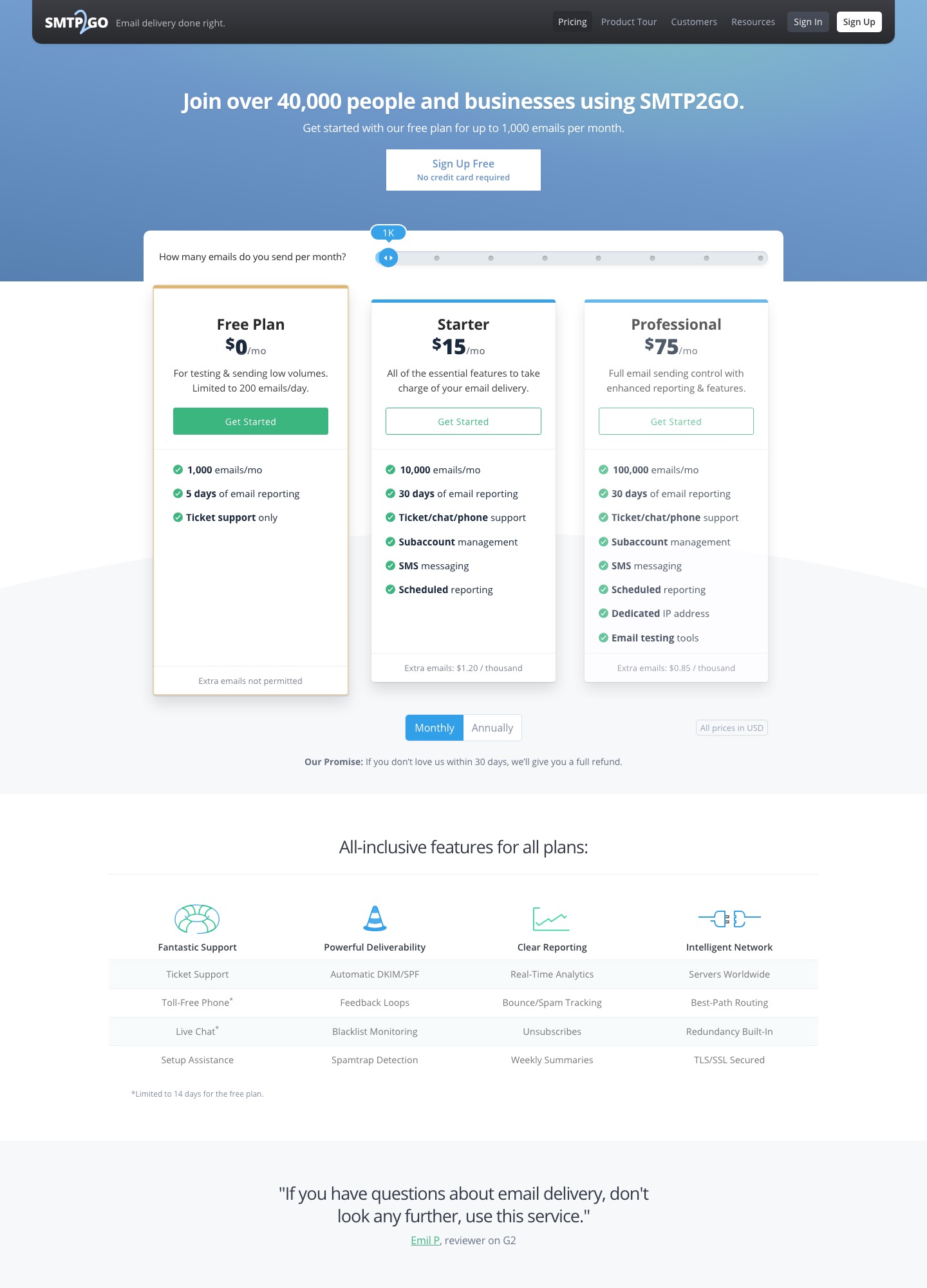
What the three plans give you
Free is 1,000 emails a month (200 a day) with five days of reporting and ticket-only support, and no extra emails allowed. Starter is $15 for 10,000 emails with 30 days of reporting, chat and phone support, and $1.20 for each extra thousand. Professional is $75 for 100,000 emails at $0.85 per extra thousand. Our SMTP2GO pricing page has the plan table in full.
Starter adds subaccount management, SMS messaging and scheduled reporting. Professional adds a dedicated IP address and email testing tools on top. All of this is on SMTP2GO's pricing page, which prices annually at ten times the monthly rate ($150 and $750 a year) and promises a refund within 30 days.
Where SMTP2GO stops fitting
The free plan cannot absorb a spike
One thousand emails a month with a 200-a-day ceiling is a testing tier, and the page says extra emails are not permitted on it. A small product that sends a thousand password resets after a bad deploy has to upgrade. Resend lets you send 3,000 a month on its free plan, Mailtrap 4,000 and MailerSend 500; none of them lifts the daily limit on free, so the real benefit is headroom over a month, not a burst.
Overage makes the middle expensive
Starter at 20,000 emails costs 15 + 10 × $1.20 = $27, which compares well. At 30,000 it costs $39, already above Mailgun Foundation's $35 for 50,000 emails. Past roughly 14,000 emails a month Resend's $20 plan for 50,000 is cheaper, and Mailtrap lists $20 for the same 50,000. SMTP2GO's break-even against Professional is at 60,000, since 15 + 50 × $1.20 = $75 exactly.
A dedicated IP means $75
Only Professional lists a dedicated IP address. For a sender at 12,000 emails a month that wants its own reputation, that is a five-fold jump. Alternatives price it differently: Mailtrap puts the dedicated IP with automatic warm-up at its Business plan, $85 for 100,000; Mailgun puts dedicated IP pools in Scale at $90.
Subaccounts and SMS are bundled, not optional
Starter includes subaccount management and SMS messaging. If an agency uses subaccounts to keep client reputations apart, check the replacement for the same: Mailtrap lists sub-accounts on Business, and MailerSend lists an SMS API on its Starter plan, although for US and Canadian numbers only. A service without either is a workaround rather than a replacement.
Cost at 10,000, 50,000, 100,000 and 250,000 emails
| Provider | 10,000 | 50,000 | 100,000 | 250,000 |
|---|---|---|---|---|
| SMTP2GO | $15 | $63 | $75 | $202.50 |
| Resend | $20 | $20 | $90 | $225 |
| Mailtrap | $15 | $20 | $30 | $200 (Business) |
| Mailgun | $15 | $35 | $90 | $255 |
| Amazon SES | $1.60 | $8 | $16 | $40 |
| Postmark Basic | $15 | $55 | Not a slider stop ($115 at 125,000) | Not a slider stop; check Postmark's slider |
| MailerSend | $13.80 | $31.50 | Set by slider | Set by slider |
SMTP2GO's 250,000 figure is Professional's $75 plus 150 × $0.85. Resend's is Scale's $90 plus 150 × $0.90. Mailgun's takes Scale's $90 plus 150 × $1.10, the lowest overage it lists, so it is a floor. MailerSend's $13.80 is its $6.30 Hobby plan for 5,000 emails plus 5,000 extra at $1.50 each thousand, and $31.50 is the Starter plan for 50,000. Above that, MailerSend's price depends on a slider on its pricing page, and its own FAQ quotes $68 for 100,000 emails on Starter, so read that number off the page for your volume. Postmark Basic is priced from a slider on its pricing page with stops at 10,000, 50,000, 125,000 and 300,000; on October 7, 2026 it read $15, $55 and $115 for the first three. 100,000 and 250,000 are not stops, so those cells give no figure rather than an estimate from the $1.80 overage rate.
SMTP2GO beats Resend and Mailgun at 100,000 and 250,000 emails, but at 50,000 it is $8 dearer than Postmark Basic ($63 against $55), and Mailtrap and SES undercut it at every volume above 10,000. If cost is your only problem, those two are the answers; if it is not, the differences that matter are retention, dedicated IP access and support.
Choosing a replacement
Resend removes the arithmetic for 14,000 to 50,000 emails with one $20 plan and has a free plan three times the size. Its pricing and limits are on the Resend pricing page. Mailtrap is the lowest-cost managed option on this list, at $20 for 50,000 and $30 for 100,000, but its Basic plan keeps logs only five days against SMTP2GO's thirty. Mailgun costs more at 100,000 and gives you inbound routing and a longer plan ladder.
Amazon SES is for teams that want the lowest bill and will build the dashboards, suppression handling and alerting; see the SES pricing guide. Postmark trades price for message-level support and strict stream separation; compare it on the Postmark pricing page. MailerSend is the closest to SMTP2GO in scope, since its free tier includes an email API, SMTP relay and a drag-and-drop builder, and its Starter plan lists 10 domains and 7-day activity data.
Moving an SMTP-based setup
Stay on SMTP first
Many SMTP2GO accounts are connected by SMTP credentials in application config, printers, CMS plugins and legacy scripts. Mailgun, MailerSend, Mailtrap and Amazon SES each list an SMTP relay or SMTP interface, so the lowest-risk first step is to swap the host and credentials and leave the code alone. Move to the provider's HTTP API afterwards, if you want per-message metadata.
Rebuild reporting you relied on
SMTP2GO's Starter plan lists scheduled reporting and 30 days of reports. If someone reads a weekly summary email, set up the new provider's equivalent or an export before you disable the old account, because the replacement may not send a digest at all.
Subaccounts and DNS
Create one sender domain per subaccount at the new provider and move them one at a time. Publish SPF and DKIM for the new provider on a subdomain, keep SMTP2GO's records until its last delivery is finished, and do not delete the account until bounces and complaints from the old route have been exported.
Related pages
For plan detail see the SMTP2GO pricing guide; for similar crossovers see Resend vs Mailgun, Postmark vs Mailgun and Mailgun alternatives.
FAQ
Is SMTP2GO's free plan enough for production?
Only for very small senders. It allows 1,000 emails a month, 200 a day, five days of reporting and ticket-only support, and the page states that extra emails are not permitted.
At what volume should I move from Starter to Professional?
Around 60,000 emails a month, where Starter plus overage reaches $75. Professional also adds a dedicated IP, so it may be worth it earlier if reputation is the concern.
What is the cheapest alternative with 30-day reporting?
SMTP2GO Starter already lists 30 days at $15. Of the alternatives, Mailgun lists 30-day log retention on Scale at $90 and Mailtrap on Enterprise at $750.