ActiveCampaign vs Drip for SaaS and online stores
ActiveCampaign and Drip both bill by the number of contacts, but they sell different products. ActiveCampaign has four email plans billed annually, starting at $15 a month for 1,000 contacts, and it carries a CRM that can grow into deal pipelines. Drip has one slider: $39 a month covers 1 to 2,500 people, and its pitch is segmentation that follows browsing and buying, with revenue traced back to the email that earned it. At 10,000 contacts the cheapest ActiveCampaign plan is $149 and Drip is $154, but that cheapest plan limits each automation to five actions, so the fairer match for Drip is ActiveCampaign Plus at $189.
What each pricing page actually sells
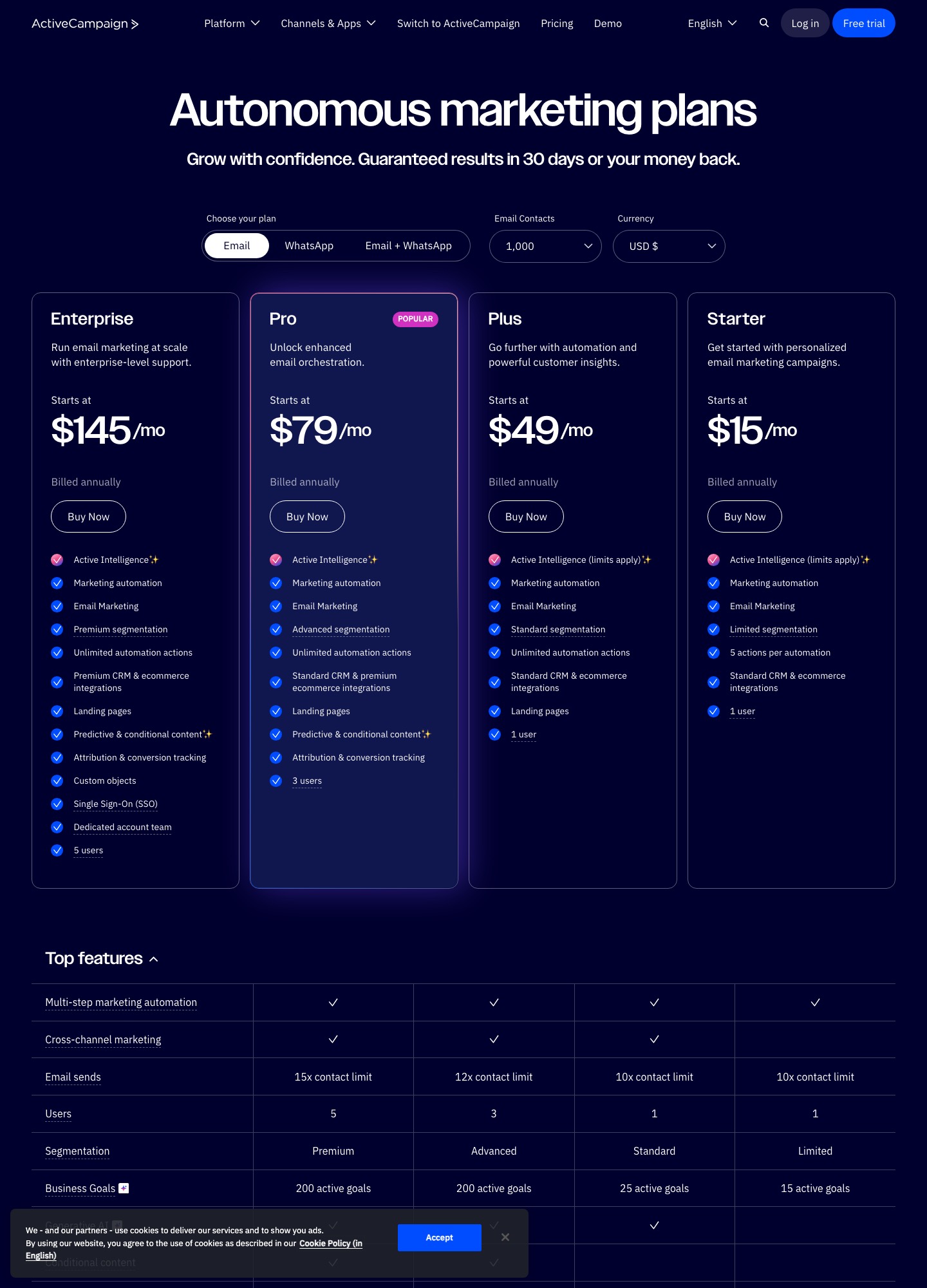
ActiveCampaign's pricing page lists Starter, Plus, Pro and Enterprise, each marked "Billed annually" with a contacts selector that reprices every card. Starter has limited segmentation, 5 actions per automation and 1 user. Plus drops the action cap, adds standard segmentation and landing pages, and still has 1 user. Pro lists advanced segmentation, predictive and conditional content, attribution and 3 users. Enterprise adds custom objects, single sign-on, a dedicated account team and 5 users. Email sends are capped at 10 times your contact count on Starter and Plus, 12 times on Pro and 15 times on Enterprise.
Drip's pricing page states that your cost depends on the number of active people in the account and the volume of email you send in a month. The entry tier lists unlimited email sends, dynamic segments, onsite campaigns, up to 50 workflows, open API access, free migration and personalized onboarding, and the page says all of it is included at every list size. Its trial is 14 days, with no credit card required.
Cost from 2,500 to 50,000 contacts
Each ActiveCampaign figure below is the monthly equivalent shown on the Email plan cards after choosing that contact count, so the plan is billed for a year at a time. Each Drip figure is the price per month shown at that list size. Both were read off the live pages on October 7, 2026.
| Contacts | ActiveCampaign Starter | ActiveCampaign Plus | ActiveCampaign Pro | Drip |
|---|---|---|---|---|
| 2,500 | $39 | $95 | $149 | $39 |
| 5,000 | $79 | $145 | $205 | $89 |
| 7,500 | $109 | $169 | $289 | $124 |
| 10,000 | $149 | $189 | $375 | $154 |
| 15,000 | $231 | $265 | $465 | $209 |
| 20,000 | $311 | $329 | $549 | $289 |
| 25,000 | $391 | $389 | $629 | $369 |
| 50,000 | not offered | $609 | $969 | $699 |
ActiveCampaign Starter is cheaper than Drip up to 10,000 contacts: $89 − $79 = $10 less at 5,000 and $154 − $149 = $5 less at 10,000. Drip takes the lead from 15,000, at $209 against ActiveCampaign's $231. Starter's own page note says it is only available on plans with 25,000 contacts or less. Against ActiveCampaign Plus, the first plan without the five-action cap, Drip is cheaper at every size up to 25,000, and the gap at 10,000 is $189 − $154 = $35 a month, or $420 a year. The order flips at 50,000, where ActiveCampaign Plus is $609 and Drip $699, so the saving is $699 − $609 = $90 a month. Drip's readouts at 40,000 and 50,000 people list 480,000 and 600,000 email sends rather than unlimited sends, which matters for stores that mail a large list often.
ActiveCampaign's own article on the true cost of email marketing says it charges once per unique contact, however many automations, tags or segments that contact sits in.
CRM and sales pipeline against shopper activity
This is the real dividing line. ActiveCampaign's plan cards include contact profiles, custom fields, tags and a standard CRM, and its pricing page offers a Pipelines add-on (deal records, account records, lead scoring) and a Sales engagement add-on on top. Those add-ons are listed without a price on the plan cards, so budget for a sales call if deals matter. Pro adds premium ecommerce integrations, and Enterprise adds premium CRM integrations, which the plan table names as Salesforce and Microsoft Dynamics.
Drip's page lists no CRM and no deal pipeline. What it lists is Shopify, WooCommerce, BigCommerce and 90-plus one-click store integrations, ready-made welcome, abandoned cart and win-back flows, and revenue reporting by order rather than by opens and clicks. If your database of record is a store catalogue, Drip's data model is closer to what you already have. If it is a list of accounts that a salesperson works, ActiveCampaign's is.
Events, API and transactional mail
Drip's REST API lives under https://api.getdrip.com/v2/ and authenticates with your API token as the username in HTTP Basic auth, with an empty password. Its API reference documents recording an event like this:
curl -X POST "https://api.getdrip.com/v2/YOUR_ACCOUNT_ID/events" \
  -H "Content-Type: application/json" \
  -H 'User-Agent: Your App Name (www.yourapp.com)' \
  -u YOUR_API_KEY: \
  -d @- << EOF
  {
    "events": [{
      "email": "john@acme.com",
      "action": "Logged in",
      "properties": {
        "affiliate_code": "XYZ"
      },
      "occurred_at": "2014-03-22T03:00:00Z"
    }]
  }
EOF
The docs say it answers 204 No Content when it succeeds. Drip allows 3,600 individual requests an hour and 50 batch requests an hour, each batch carrying up to 1,000 records. A workflow can be started for a subscriber through its own endpoint, and the webhook list includes subscriber.performed_custom_event, so a custom event can also call back into your app. The reference's section list covers subscribers, tags, segments, workflows, broadcasts and webhooks, and it has no endpoint for sending a one-off transactional message.
ActiveCampaign records an event through a separate tracking host. Per its track event reference, you post form-encoded fields: your account's actid and event key from Website, Site Tracking, the event name (32 characters at most), optional event data, and the contact's email as JSON.
curl --request POST \
 --url https://trackcmp.net/event \
 --header 'content-type: application/x-www-form-urlencoded' \
 --data 'actid={{actid}}&key={{key}}&event={{event}}&eventdata={{eventdata}}&visit=%7B%22email%22%3A%22{{email}}%22%7D'
Its general REST API has a limit of 5 requests per second per account. Its webhooks documentation says webhooks are never retried and are switched to inactive after an HTTP 410 response, so a receiver that is down for a deploy loses events unless you reconcile later. For password resets and receipts, ActiveCampaign sells a transactional add-on that is Postmark by ActiveCampaign; our Postmark pricing page covers that service on its own.
Which one to pick
Choose ActiveCampaign Plus or Pro if a salesperson follows trial users or leads, if you want a lead-to-deal pipeline in the same tool, or if your list is near 50,000 contacts, the one size where Plus undercuts Drip in the readouts above. Choose Drip if you run a Shopify, WooCommerce or BigCommerce store, if the first thing you want to build is abandoned cart or win-back flows, or if you want a single price with no plan ladder to work through. Choose neither as your only sender if reset links and invoices must arrive in seconds: pair either one with a transactional API such as Resend or Postmark. The Resend vs Postmark comparison and the transactional versus marketing email guide explain why those streams are better kept apart.
Moving from one to the other
Export contacts with their custom fields, tags and unsubscribe status first, and plan to rebuild automations by hand because they do not transfer between the two. Drip lists free migration and personalized onboarding among the entry tier's features, so ask for that before rebuilding anything. Count your automations before you move to Drip: the entry tier lists up to 50 workflows, while ActiveCampaign Plus and above have no action cap but limit sends to 10 to 15 times your contacts. Re-point your application's event calls, since the two APIs use different hosts, authentication and payload shapes, and keep event names within ActiveCampaign's 32-character limit if you are moving in that direction. Publish the new sending domain's DKIM and SPF records before the first send, and keep the old tool's unsubscribe export until the first full month of sends is clean.
Related reading: Customer.io vs Drip for event-driven SaaS lists, Userlist vs Customer.io for company-level data, and email tools for B2B SaaS.
FAQ
Is ActiveCampaign cheaper than Drip?
Only at small list sizes or very large ones. Starter is cheaper through 10,000 contacts but caps automations at five actions, and Plus beat Drip only at the 50,000 readout, where it costs $609 against Drip's $699.
Does Drip include a CRM?
Its pricing page lists segments, workflows, onsite campaigns and revenue reporting, and no CRM or deal pipeline. ActiveCampaign includes a standard CRM and sells Pipelines and Sales engagement as add-ons.
Which one can send transactional email?
ActiveCampaign lists a transactional email add-on, which is Postmark under the ActiveCampaign name. Drip's API reference has no transactional send endpoint, so use a separate transactional service for resets and receipts.
Does either have a free trial?
Drip offers 14 days with no credit card. ActiveCampaign's pricing page carries a Free trial button but does not state its length, and neither lists an ongoing free plan.